

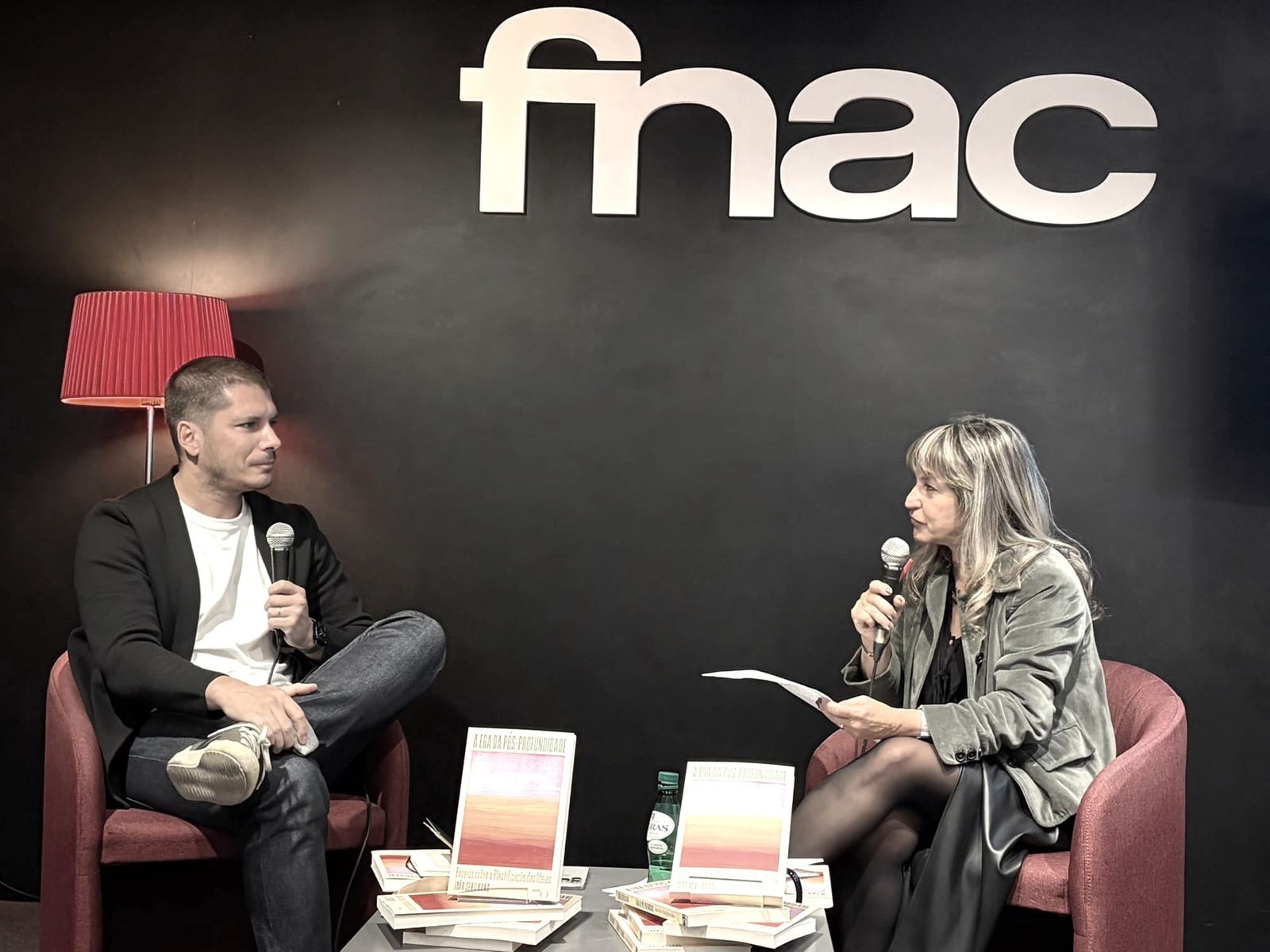
After Lisbon and Porto, A Era da Pós-Profundidade had its third launch session on Sunday 8 November, at the Fnac in Gaia, across the river from Porto, with the philosopher Sofia Miguens. Two weeks earlier, on another Sunday, Inês Lopes Gonçalves had talked about it on television. I am writing about both for the same reason I wrote "eight days": it helps me think about what happened.
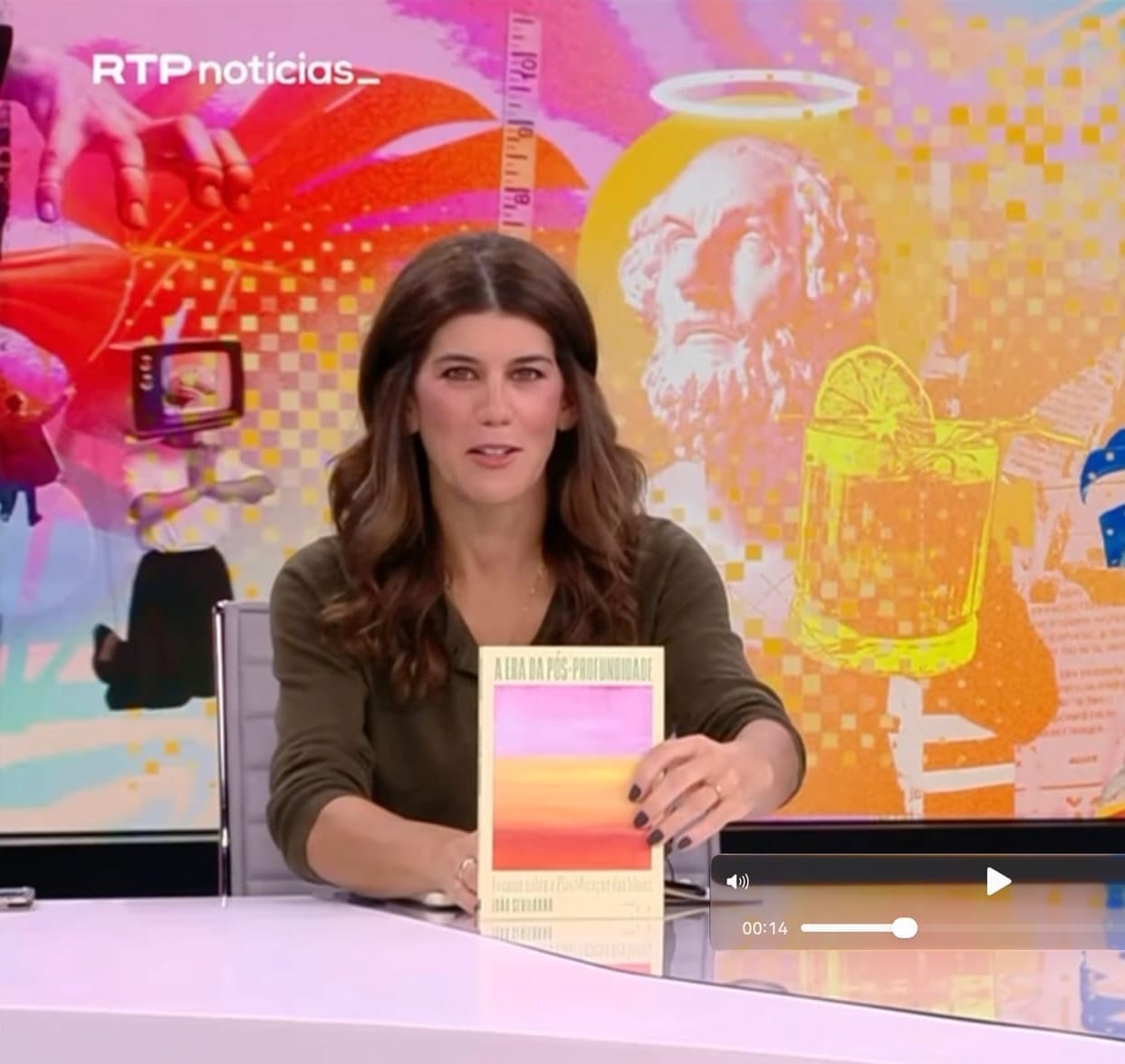
On 25 October, Inês Lopes Gonçalves talked about the book on 15 Segundos de Fama (15 Seconds of Fame), the weekly programme about pop culture on RTP Notícias, the news channel of the Portuguese public broadcaster. Tiago Ribeiro hosts it, with her, Ana Markl, Henrique Costa Santos and Tiago Pereira on the panel. That week's episode was, among other things, about noise and the power of words, I read in the description. It was one of those moments that help explain what intuition is, which I like to define as "something you know without knowing how you know it". I watch little television. That Sunday, for no reason I can give, I flicked through the news channels. I stopped on that programme, which I did not know. It was almost over, but I was intrigued. As it was a programme about culture, I decided to go back in the recording. A few clicks of the remote later, I saw the cover of my book. I kept the moment as best I could, filming the television, at the suggestion of my wife, another Inês, to whom I had excitedly told what had just happened. Days later, I got an email from a friend saying he had seen the same episode.
The book was Inês Lopes Gonçalves's pick for that week, in the part of the programme where each of them says what to follow. She held it up to the camera, checked that it could be seen properly and summed it up: we live in a time of ready-made phrases, in which subjects studied for years, and perhaps still not settled, are boiled down to one-minute reels; everyone seems to be certain, everything is content, and we are full of books telling us how we should think and feel, none of which leaves us any time to think and to feel.
Thank you, Inês!
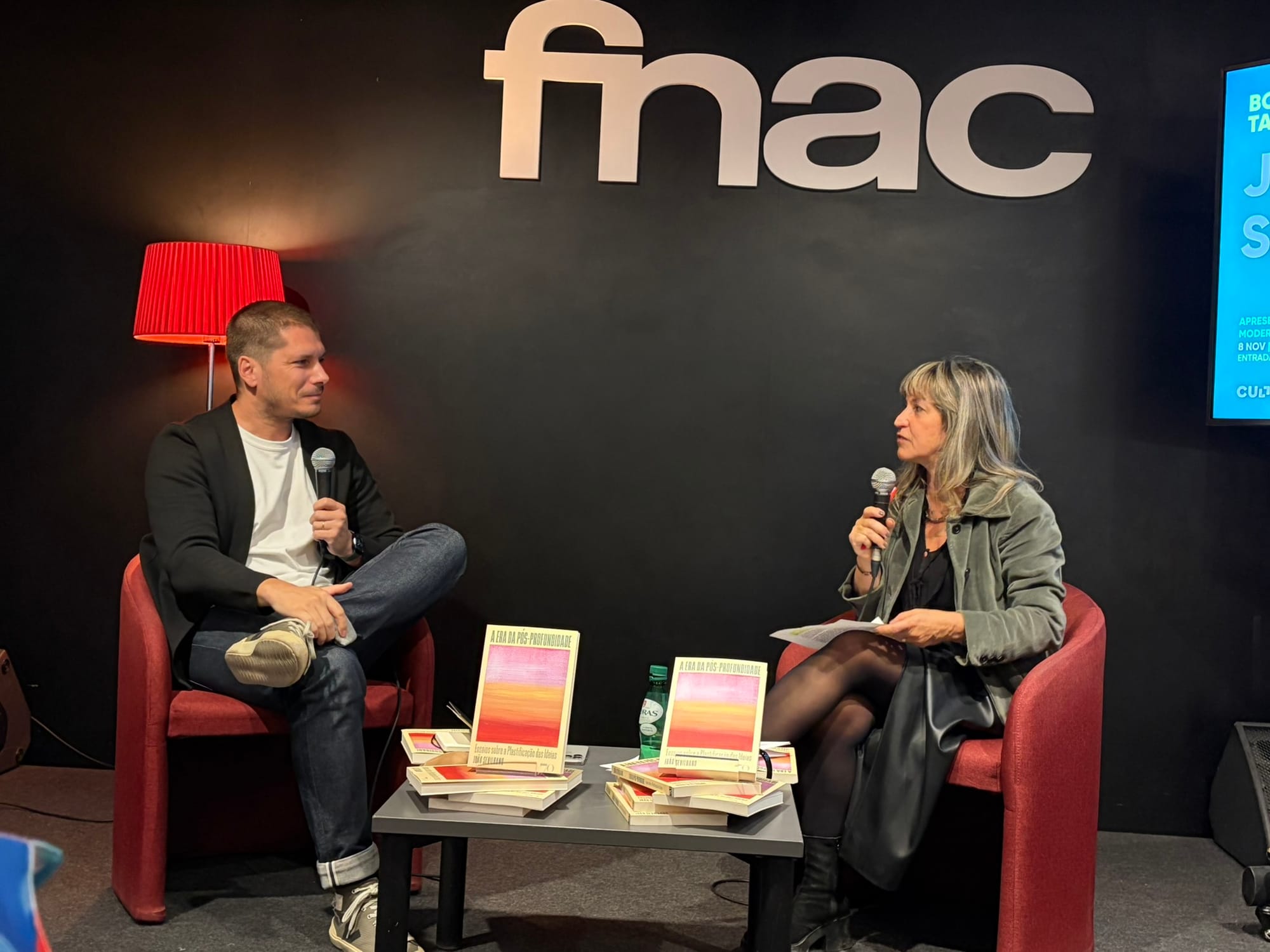
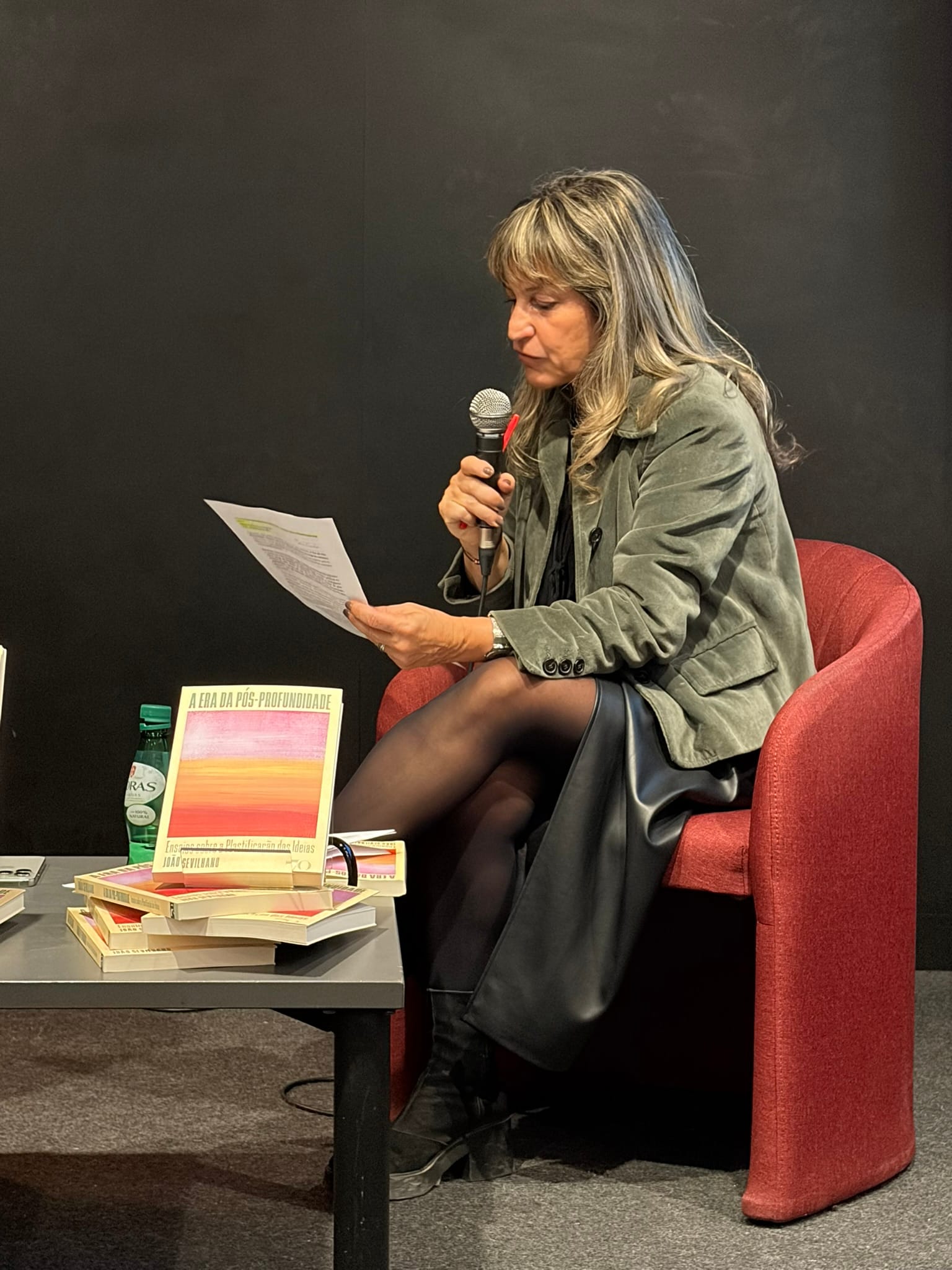
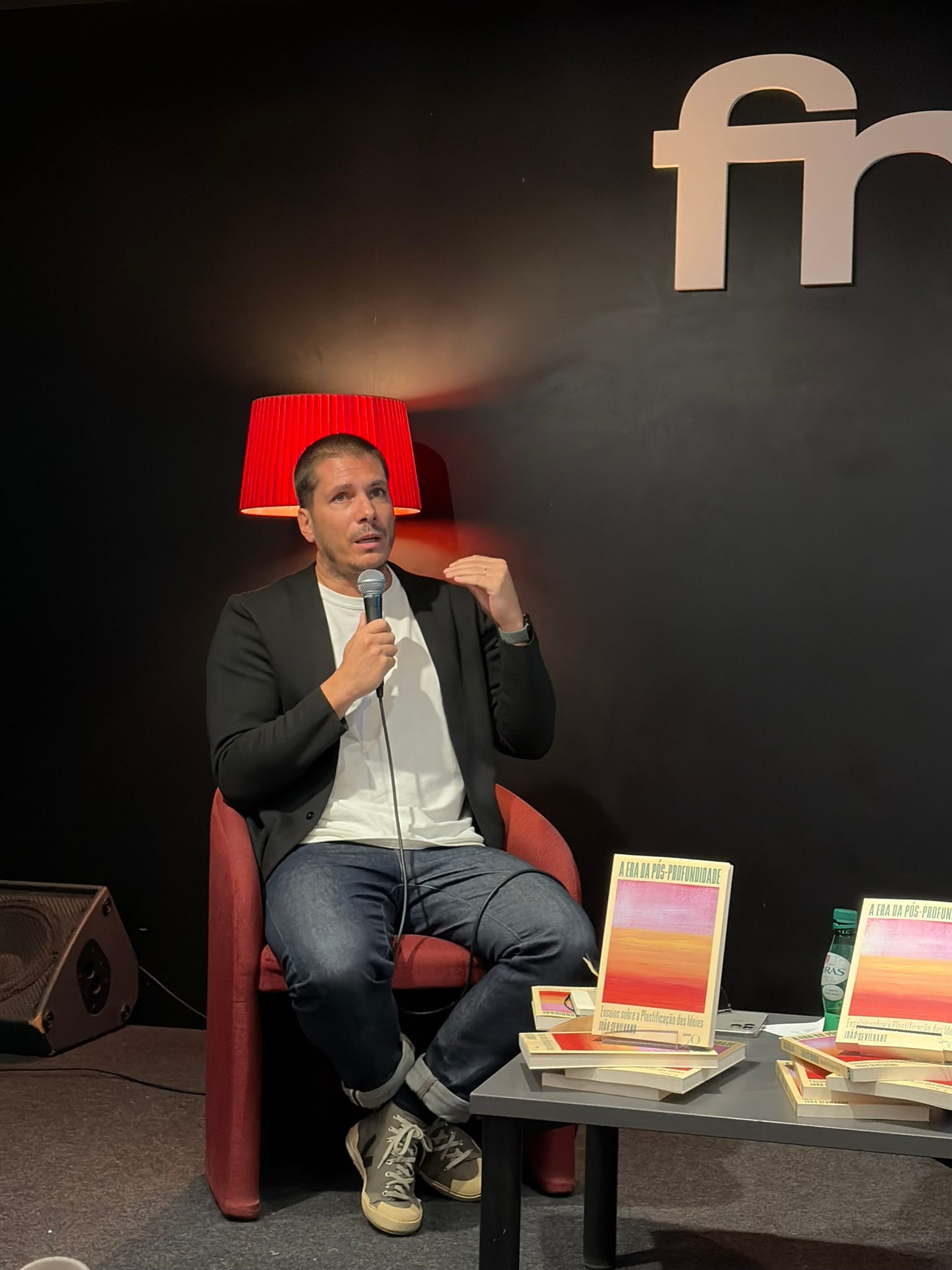
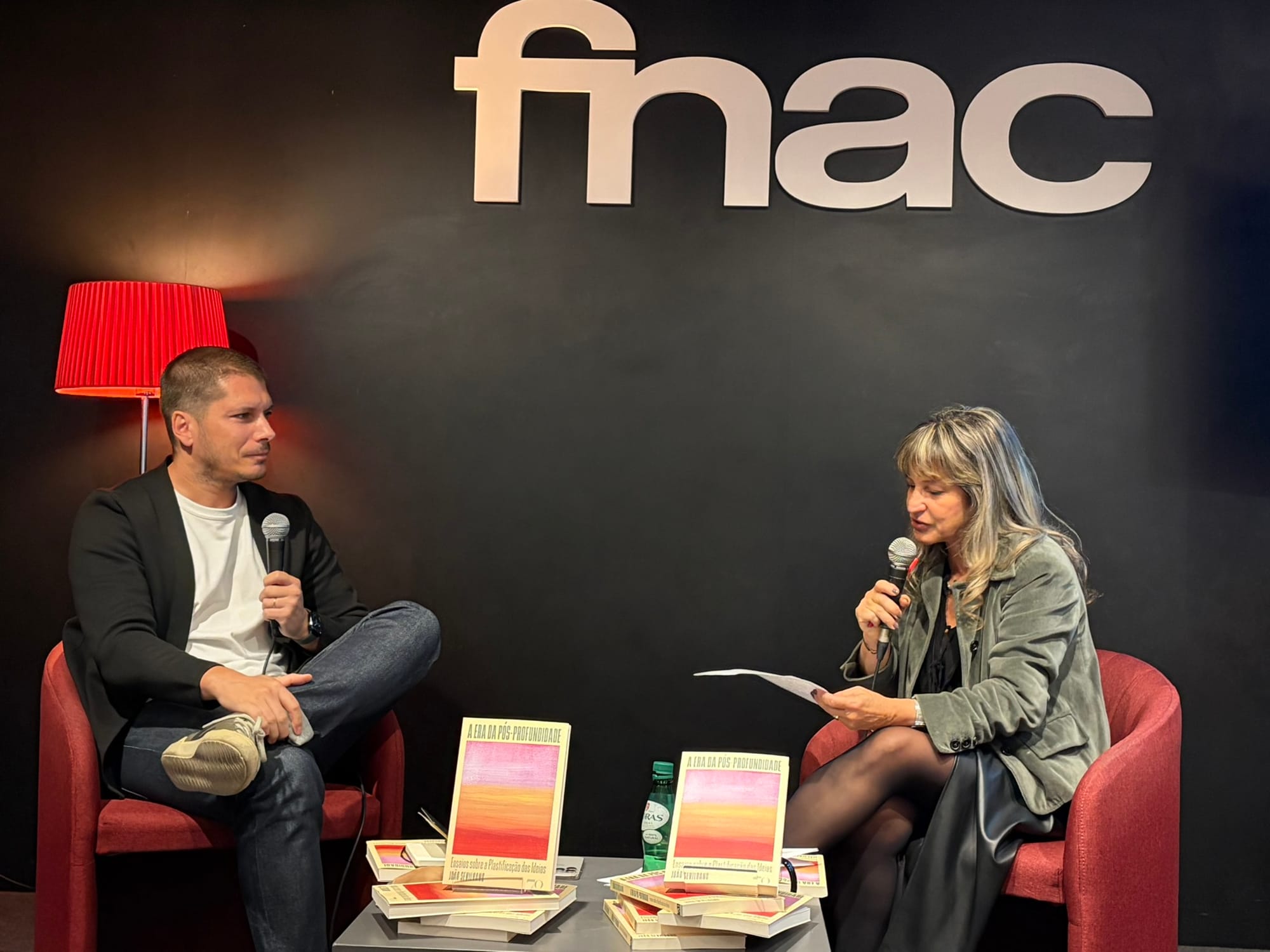
Sofia, a philosopher and, like me, an Edições 70 author, did not know me, nor I her, though I had read one of her books (Mentes Humanas, Animais e Artificiais: O Trabalho das Palavras a Partir de Daniel Dennett, roughly Human, Animal and Artificial Minds: The Work of Words, after Daniel Dennett): it was João Moita, editor to us both, who brought us together. She arrived in Gaia with my book read and with a list of every philosopher I cite in it.
I was happy to see the café full, happy with Sofia's excellent reading, happy to see again people I knew and to meet others I had never come across. Sofia called the book a "brilliant and accurate diagnosis" of our epistemic and existential condition, and said the chapters on AI are among the best things she has read on the subject. She also praised the effort of saying in Portuguese what is usually said in English.
She read it as the self-analysis of a psychologist who knows well what companies ask of psychology, the same companies that push people into unsustainable situations and then ask him to treat them. Ours, she said, is the time of "radical paradoxes of work". I answered that it was all inside the same cycle, a cycle of perversity.
She also recalled that psychologists are under no obligation to respect philosophy and that the relationship between the two is one of mutual incomprehension; and she said that, even so, I was doing what many philosophers can no longer do: taking philosophy outside the walls of the academy. I did not study philosophy formally and so feel little entitlement to call myself a philosopher. On the other hand, I have read and studied far more philosophy than psychology. What does that make me?
To close her part, she read aloud the passage in which I confess to examining the cauldron from inside the cauldron: "Like Obelix, I keep asking for more magic potion without noticing I no longer need any."[^Obelix, in the Asterix comics, fell into the cauldron of magic potion as a baby and has been strong ever since. The passage is also in "i wrote a book".] She said she admired that self-diagnosis. When my turn came, I said I had been afraid this would happen: that Sofia would pick up the book and give it "a sturdiness I don't see in it". In truth, I was hugely excited to be having that conversation.
She also asked me four questions, and none got a direct answer. I blame the excitement. Halfway through, I admitted that I had let myself be carried away by my activist streak and lost the thread. I leave them here, because I found them strong and precious. Sofia gave me more fuel for thinking and for writing.
The first, if I remember rightly, went something like this: if post-depth inherits postmodern relativism, where does the strength come from to speak of emancipation, transformation or revolution? (She cited Kate Soper, post-capitalism, post-democracy, the post-growth literature.)
Another was about work: she wanted to know what I wanted to happen. That we all stop working? To this one I dare to venture a short answer: no. I would rather we found new ways of relating to work, which would mean opening, or forcing, room to redefine what working means.
The third: whether Byung-Chul Han, whom I cite several times in the book, with his small, popular books, looked at askance by German academia, is not himself an example of the plasticisation of ideas. I too wrote short essays and invented a "glue-concept".
I remember a fourth, about the book's final chapter: "how does conversation, which you propose as a way out, connect to the idea that post-depth has made us too literal and too serious?" I would have loved to answer this one. I believe the answer is in my book and, for readers of this newsletter, in what I have written here about conversation.
I wish I had had more time to explore with Sofia the ins and outs of the academic world, compared with the corporate one, because there seemed to be some tension there worth using. I hope we have more conversations.
From the audience came a question about the ethics one learns in order to keep doing the same thing in a more acceptable way. I remembered the training sessions I have taken part in: in ethics workshops everyone is very ethical; then comes real life.
At the end, a former client asked me what the alternative is to a business model that, as he sees it, works and seems unstoppable. I don't know, and told him so. Earlier, he had said that from our conversations about corporate bullshit he had learned he was not mad. I told him that in that case I was mad too.
"Or else we all are," he said.
English adaptation of "Dois domingos", published in úteis inutilidades on 15 November 2026: https://uteisinutilidades.substack.com/p/dois-domingos
This is a reader supported publication. If you enjoy the content, please consider a paid subscription or a donation. Also, if you thought of someone while reading the content, don’t hesitate to share it with them.