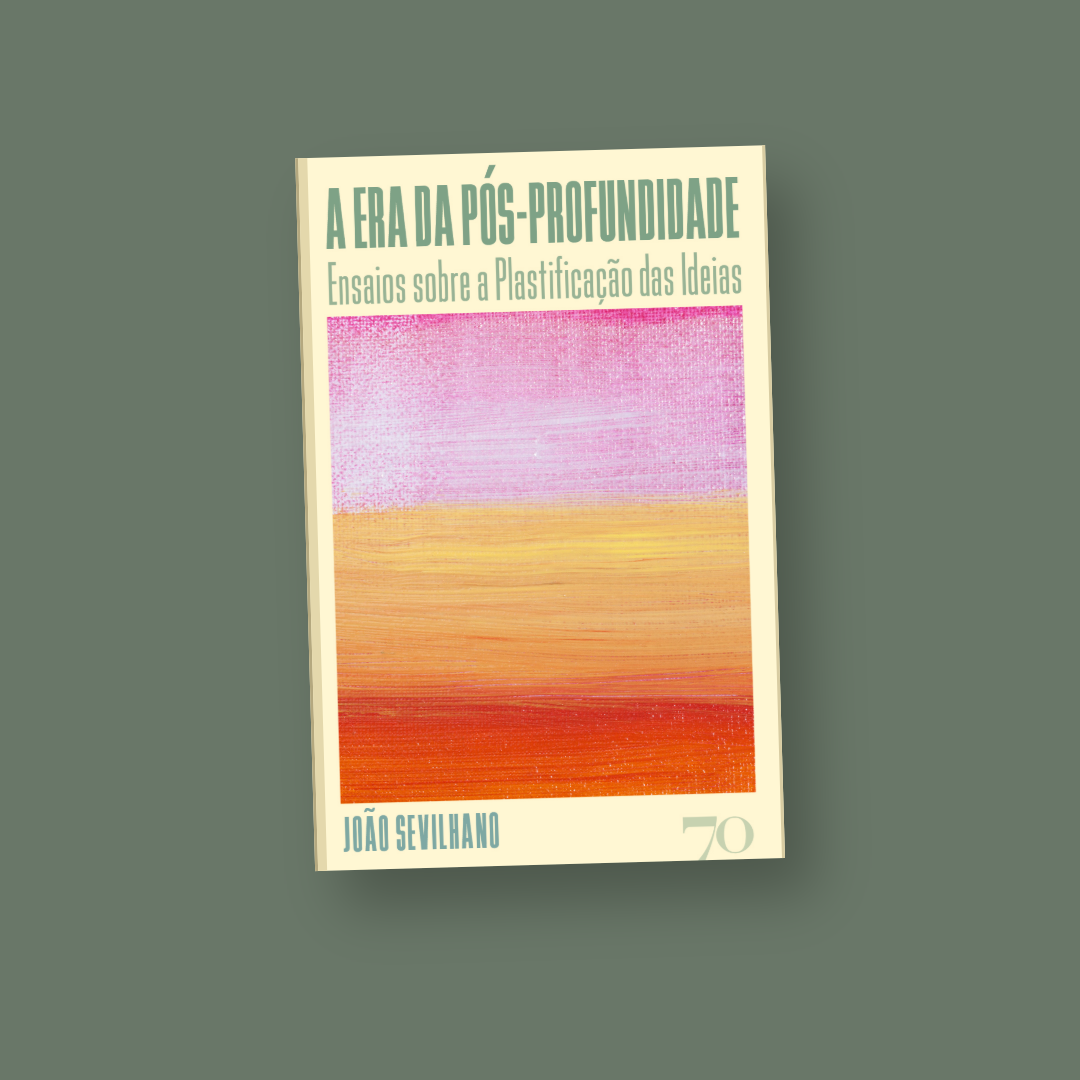
I wrote a book. It comes out on 3 September, from Edições 70, with a preface by the philosopher André Barata. It is called A Era da Pós-Profundidade — Ensaios sobre a Plastificação das Ideias: roughly, The Age of Post-Depth — Essays on the Plasticisation of Ideas.
It is in Portuguese. Some of you read Portuguese — I know, because you write to me in it — but most of you don’t, and I have been putting this piece off because there is something faintly absurd about announcing an object to people who have no way of using it. So let me be plain: this is not a sales pitch. For most of you there is nothing here to buy, and that is fine.
What there is, is the argument. I have been building it in these letters for over a year, mostly without telling you that’s what I was doing. Though “argument” flatters it: it began as a suspicion, gathered over almost twenty years of moving between two worlds that behave like oil and water — clinical psychology and corporate consulting. The suspicion is this: we have not lost depth.
The usual claim runs the other way. We are told we have become shallow, that nobody reads, that attention has splintered, that short video ate our brains. I started there too, and I was wrong.
Meaning, purpose, authenticity, ancient wisdom — these have never been discussed more. Stoicism has never sold better. There have never been more people announcing that they intend to slow down. The appetite is intact, and it is loud.
What broke is harder to see: recognition and discernment. We stopped being able to tell the thing from its imitation, and so we accept anything that uses the right words. Five minutes of mindfulness. Three steps to success. A two-day workshop promising transformation.
Hence the title. Post-depth is built the way post-truth is built. Nobody proposed abandoning truth; what went missing was the criterion for identifying it. Same here. The prefix does not mark absence — it marks what comes after, when the thing is still invoked, still wanted, and no longer recognised when it turns up.
Daniel Dennett lent me a word for one variety of this. He called them deepities: statements with two readings, one true but trivial, the other profound but false. “Love is just a word.” On one reading, true and empty. On the other, meaningful and almost certainly false. The speaker gets the glow of the second and, if challenged, retreats to the first.
I translated deepities as profundidadezinhas, and the translation is better than the original — which is not a thing one often gets to say. Portuguese has a productive diminutive: stick -zinho or -zinha on almost any noun and you get a smaller, often fonder version of it. Profundidade is depth. A profundidadezinha is a little depth. Depth in miniature. Gregório Duvivier, the Brazilian poet and comedian, has a lovely bit about how we Portuguese speakers use diminutives to say things that Anglo-Germanic languages have no room for.
The English word accuses the sentence of being false. The Portuguese word accuses it of being small, which is both more accurate and more damning. A deepity is not a lie. It is a scale model of a thought, sized to fit on a card, a slide, an office wall.
There is a vertigo in this criticism, and I would rather name it myself before somebody names it for me. I am using postmodern tools — irony, deconstruction, the critique of commodification — against the thing I am calling post-depth. Am I Baron Münchhausen, hauling myself out of the swamp by my own hair?
Perhaps. And perhaps that is the point: post-depth is not what comes after postmodernism but its apotheosis — the simulacrum that has lost any awareness of being one. Admitting it forces a confession: I am examining the cauldron from inside the cauldron. Like Obelix, who fell into the magic potion as a baby and has been strong ever since, I keep asking for more of it without noticing I no longer need any.
The only honesty available is that of someone who lives inside the contradictions knowing he is part of them.
Which also explains what the book does not do. There are no exercises, no protocol, nothing to apply on Monday morning. It is a book of diagnosis, not treatment, and of the few things I am sure of, one is a distrust of anyone selling quick-fix-treatments.
What the book does is more modest than I expected when I started. It gathers a handful of words that helped me name what I was feeling and could not say.
Some are borrowed, from good houses — Dennett’s, and Harry Frankfurt’s distinction between the liar and the bullshitter, with an amendment from G. A. Cohen that I find decisive. Others I had to make up, which I mention without pride: coining a word, an expression, is always an admission of some ignorance or unawareness. The first time I wrote burocrata emocional — emotional bureaucrat — it was out of exhaustion at having no way to say it.
For those of you who do read Portuguese: it is here, and I would be glad if it found its way to you. For everyone else: the essays in this publication are the book, more or less — though I confess the two are not the same. I would love to have it translated one day, and English would come first, for all the reasons you can guess.
And in either case there is a way out. I wrote in the prologue that if this book does its job, it will make itself unnecessary to whoever reads it. I see no reason for you not to start there.