

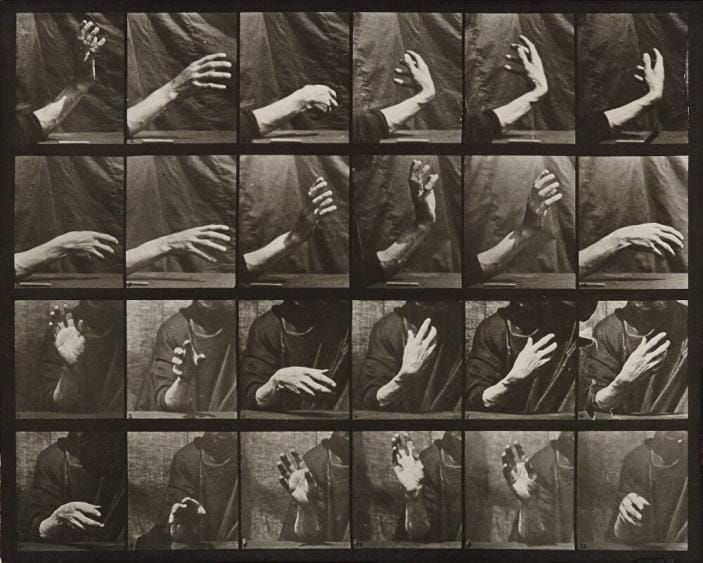
I remember Gonçalo M. Tavares speaking and writing about how technique — technology — is leaving us with fewer gestures while, at the same time, we use the same gestures for very different digital things.1 Before, for instance, when I played console games with my friends or with my brother, we were all in the same room, planted in front of the same screen, tied by wires to a machine. The removal of the wires changed the experience. The connections became invisible (English was ready for this: it had wireless waiting, one word, ordinary. Spanish coined inalámbrica. Portuguese, the language I think in, never got the adjective — we say sem fios, “without wires”, a description standing where a word should be. I catch myself envying my neighbors’ vocabularies: had we the word, I would write that our relations had become wireless ones). As technology advances, as capacity and speed increase, what is being lost? And what was never gained at all, for those who had no contrasting experience?
The same writer, as it happens, has already written about this. It’s enough to recall the title of one of his books: Learning to Pray in the Age of Technique. The reader may gather that it was from that title that the title of this modest essay was engendered.
Today, on the Saturday on which I’m writing — curiously, because the first words of this text were written two weeks ago —, Inês told me, while we were still talking in bed, before getting up for the weekend’s errands, that it was a pity today’s kids (I believe she meant ours, but not only ours) don’t have posters of idols in their bedrooms. I nodded and replied that today’s idols, if they exist, live in the digital world, have strange nicknames, and go by words ending in “ers” — youtubers, gamers, influencers.
I will not become one more tedious writer denouncing “the digital” as the seed of all evil (an intentionally corny phrase). Gestures began to change with mechanics. Still, until the rise of the current technologies, utensils and tools demanded manipulation. They didn’t eliminate gestures; they generated different ones. Was electricity the first great assassin of gestures?
Before, for example, to toast bread we had to light the stove, lay the slices on the metal plate and, hoping to get the timing right, turn them when our taste demanded it. It required, at any rate, a more or less attentive vigilance, to improve our precision. Now, whatever the model, we push down a lever after turning a knob to set the time, on a scale that doesn’t measure it: we believe we’re programming how toasted a slice will be when, in truth, we’re programming how long we have to wait for it to jump. In this case, the toaster didn’t eliminate gestures; it only modified them, simplifying them. Besides, the wait is now free for other activities, since the little machine announces the end of its duty with a mechanical clunk.
Other electrical appliances did away with a more vigorous use of the body. The electric coffee grinder, for one, eliminated the rotary movement that demanded coordination between fingertips, fingers, wrists, forearms, biceps, shoulders, eyes, a few abdominals. Now we press a button. The button may well have been the greatest exterminator of gestures in History.
Where many old gestures used to be, we now have buttons. One button sets the dishes washing, another the clothes, another makes our coffee, heats our food, turns on the lights, makes the air warmer or cooler.
And yet the button was still a “thing”. It had travel, resistance, a click that confirmed the decision. The touchscreen retired it. What remains is a finger sliding on glass — and it is always the same slide, whether it pays for a dinner, buys shoes, rejects a person, signs a document or silences the news. We don’t even press any more: we caress. In fact, not even the caresses are necessary now. The phone unlocks with a glance; the payment happens by proximity. From the full gesture we moved to the button, from the button to the touch, from the touch to no gesture at all.2
Let us make a small inventory, before the memory of the gestures gets digitized too. Dialing a phone number was rotating a disc and waiting for it to come back, hoping for few nines and zeros. Winding a watch was a daily commitment to one’s own time: whoever forgot the gesture was left, literally, without the hours. Rewinding a cassette with the help of a pencil spared the player’s batteries and, in its absence, gave the index finger the function of an axle. Car windows were lowered by cranking a handle. Curiously, we still ask someone to lower a window by miming a crank that cars no longer have. We no longer twist our wrists to start an engine; we press a button or, in the newest models, it’s enough to press the accelerator. And we save documents by pressing the icon of a floppy disk the kids have never seen. Gestures die, as objects do, but they leave fossils.
The posters Inês was missing were also made of gestures: cutting the page out of the magazine carefully, so as not to take half the idol with it; borrowing sticky tape; climbing onto the chair; deciding on the wall. And there was the maintenance — the corner that insisted on peeling off. Following an influencer today asks for one touch on an immaterial “button”, hidden behind some pane of glass. The same touch that serves for everything else.
Let me linger a little longer. It’s on purpose.
Tuning a radio asked for a finger and an ear working together. You turned the knob slowly, crossed a rain of static, a remnant of a voice appeared, you overshot it, you backed up a millimeter — and there, between two hisses, sat the station. Whoever turned fast got nowhere.
Photographing was betting blind. A roll had twenty-four or thirty-six shots and no screen on which to check the result; you chose the moment with the stinginess of someone who knows each photograph costs money. Then you took the roll to the shop and waited — days — to discover that in half of them our eyes were closed and that, in the ones taken with blinding light, we came out looking like vampires. We kept those too. They had cost the same.
Looking up a word in a dictionary was a small journey with layovers: you traveled the alphabet, adjusted course by the second letter, then by the third, and along the way you stumbled on words you weren’t looking for, which went from strangers to friends. The dictionary taught by accident. The spellchecker, or the chatbot on duty, never taught us anything we hadn’t asked it.
Listening to a whole record included getting up halfway through: side A ended and side B didn’t start on its own. You had to lift the needle’s arm, flip the record, set it down again without dropping it.
And, since I began this text with consoles: when a game wouldn’t load, you pulled out the cartridge and blew into it. Nobody knew why. Everybody did it. It worked often enough that we never stopped believing.
I’ll stop here — not for lack of examples, but because I suspect the reader is beginning to show signs of impatience. If these descriptions bored you, I consider two hypotheses, plausible and not mutually exclusive. The first: that my writing is not up to the gestures it describes — a hypothesis honesty obliges me to leave on the table. The second: that reading something that makes us linger has become as costly as waiting. If four lines on the turning of a radio knob struck you as excessive, try to remember how long you could hold out, back then, hunting for a station. The boredom you may have felt is not necessarily my fault (though it may be, I insist): it may be the muscle, atrophied, complaining at the resumption of exercise.
I notice now, rereading the inventory, something I hadn’t considered while writing it: in almost all these gestures there lived a wait. The disc that came back, the toast that wouldn’t jump, the coffee ground by force of rotations. The gesture occupied the hands and left the head loose — and the loose head, with nothing to entertain it, got bored. Technique, by eliminating the gestures, eliminated the waits. I wanted to write that, by eliminating the waits, it left us exposed to boredom — but it’s the other way around. It protected us from it. No one ever has to be bored again: there is always a pane of glass within a caress’s reach. In a culture obsessed with productivity, this is booked as profit — time recovered, friction removed.3 I distrust profits like these. The boredom the gestures contained was the low-intensity kind, the bearable kind, the kind in which the head wanders because the hands are busy. It was in that boredom that one thought without noticing.
Tomorrow morning I will press several buttons. And yet, I realize it is not by accident that I’ve kept a manual espresso machine. Yes, the coffee beans are ground at the touch of a button. Yes, the machine pours out the brown liquid after I press another. But for the buttons to follow their designs, I have to gather the beans-turned-powder with a proper spoon; I have to tamp the resulting mound with a tamper I bought for the purpose, wooden handle and all; I have to find the right fit for the portafilter and turn it until it locks, sensing, by the resistance it offers, whether the amount of coffee I chose is the right one for my taste. Habit, meanwhile, pushes all of this toward automatism — the hands are quick to learn to do without us. I resist it on purpose: I take my time, so that the gesture keeps asking for my attention. Afterwards, while the coffee cools slightly, I knock out the grounds and clean everything I dirtied with water, dry it with a cloth, sweep up the powder I left scattered with a small hand brush4, leaving everything ready for the next espresso.
An automatic machine would do all of this for me in twenty-three seconds. It might even use less water. But it is not efficiency I am after in this morning ritual. Nor the optimization of time, so I could be dispatching e-mails or reading the morning news. It is an analog, artisanal stubbornness, before the rest of my day — ever more, and more, digital.
- Tavares works through the relation between body, gesture and technique in Atlas do Corpo e da Imaginação (2013), still untranslated — roughly, an atlas of the body and the imagination. ↩︎
- Giorgio Agamben, in “Notes on Gesture” (written in 1992; in English in Means Without End: Notes on Politics, 2000), dated the beginning of this loss long before any screen: by the end of the nineteenth century, he wrote, the Western bourgeoisie had definitively lost its gestures. Technique didn’t inaugurate the process; it took charge of concluding it. ↩︎
- On boredom — its demonization and what is lost when we try to exterminate it — I’ve written before, in “boredom as blasphemy” (May 2025) and in the interlude “on boredom (or what goes through your head on a 10-hour flight, without sleeping)” (July 2025). I won’t repeat the argument here; the referral stands. ↩︎
- I grumbled at and disdained this little brush when it arrived at our house, uninvited by me. May these words now serve as an act of contrition, addressed to whom it may concern: I have adopted it, affectionately. ↩︎
This is a reader supported publication. If you enjoy the content, please consider a paid subscription or a donation. Also, if you thought of someone while reading the content, don’t hesitate to share it with them.