

In 2023 — a mere three years ago — forty-one Portuguese companies tried out the four-day week. Six months, an average 13% reduction in working hours, no pay cuts. By the end, 95% rated the experience positively and more than 80% decided to keep the model.1 We weren’t the first, so we were far from original: Iceland had put 2,500 people on shorter hours between 2015 and 2019, Spain had launched a similar pilot in 2021, Microsoft Japan had recorded a 40% jump in productivity with four-day weeks. For two or three years, the covidian promise of rethinking the place of work in our lives seemed to have momentum.
I could have sworn the subject had since been dropped. Not quite. What did happen is worse, I think. We kept talking about it but we changed the verb tense. In 2023 the talk was in the present tense, with actual companies, reports and verifiable numbers; in 2026 we prophesy. The head of America’s biggest bank announces that technology will bring the three-and-a-half-day week; Bill Gates wonders aloud whether we won’t get down to two.2 Artificial intelligence, they assure us, will finally deliver the free time earlier machines still owe us. Prophecy has one clear advantage over experiment: it commits no one to anything.
Carissa Véliz, with whom I had the pleasure of sharing a stage last May, published a book on the subject this year — Prophecy, a journey from the ancient oracles to AI — in which she argues that the promise of prediction was never really about knowing the future: it was always about power over those who believe it.3 The oracle doesn’t need to be right; it needs to be consulted. And whoever convinces us that the future is already written, and that they are the ones who know how to read it, excuses themselves from negotiating the present. Seen in this light, the prophecies of the three-and-a-half-day week do their job: they appease us today while committing no one tomorrow. With an aggravating factor the old oracles never had: the modern prophet holds both ends of the trade. Whoever promises us the two-day week makes their living selling us the tools that make us fill the five-day one.
Meanwhile, back in the present tense, the data say otherwise. A study that tracked the digital activity of more than ten thousand workers concluded that, with the adoption of AI, working life has grown more intense: time spent on email and messaging more than doubled, and the use of work software rose 94%. Berkeley researchers observed that people who use AI began taking on tasks they used to outsource and squeezing bursts of work into evenings, weekends, waiting rooms.4 Focused work time, for its part, fell 9%. The state of mind this produces already has a name: AI brain fry.5 Without meaning to — and this is what strikes me as worth noting — we are doing more and thinking less.
Before settling into indignation, it’s worth turning the argument around. Nobody forced these workers to fill their waiting rooms with work: many do more because they want to, and David Brooks — the Atlantic columnist who gathered the data above — sees in this the key to the future: when intelligence is abundant, he says, what becomes valuable is the will. Could be. But each person’s choice doesn’t stay with each person. The same Brooks records that AI shifts expectations — ours and our bosses’ — about what fits inside a working day; and shifted expectations neither recede nor align themselves of their own accord. The pace some choose out of appetite becomes the ruler everyone else is measured by, and whoever works the hours in the contract goes back to being eyed sideways. The mechanism is not new but the scale looks bigger.
None of this should surprise anyone acquainted with the history of this kind of promise. Keynes, in 1930, with the world sinking into the Depression, predicted for the generation of his grandchildren a fifteen-hour week and a humanity that would once again “prefer the good to the useful”. The economic half of the prophecy seems to have come true: Keynes estimated that the standard of living would, within a century, multiply by four to eight, and in the rich countries so it did.6 We earned the productivity that was to buy the free time; the time never got to claim its freedom.
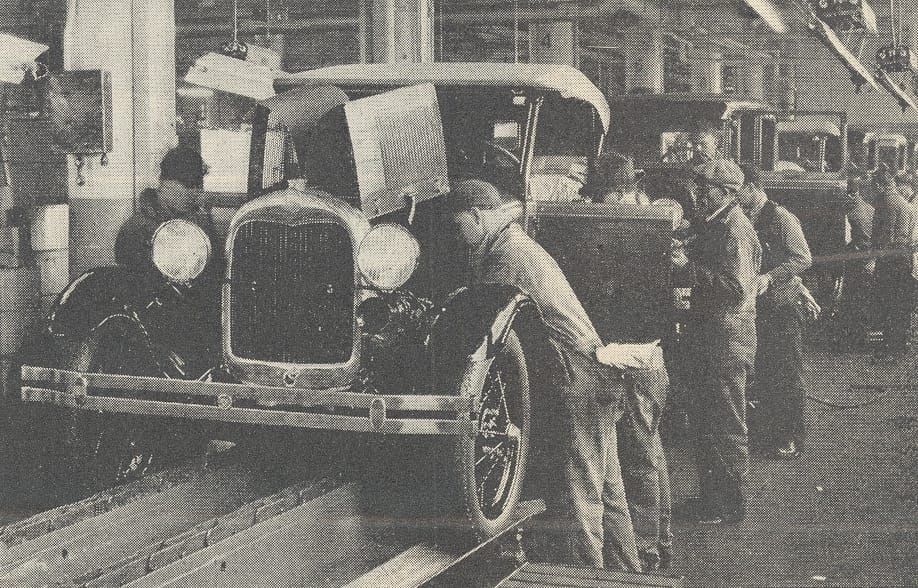
Before him, in 1926, Henry Ford had brought the five-day week into his factories with words that almost pass for a defense of the good life — it was “high time”, he said, “to rid ourselves of the notion that leisure for workmen is either ‘lost time’ or a class privilege”. He took care to undo the misunderstanding immediately: there was of course a humanitarian side to the shorter week, but dwelling on it was halfway to trouble, “for then leisure may be put before work instead of after work — where it belongs”. Rested workers worked better and, with an extra free day, bought more automobiles. Leisure entered the factory as it would enter the offices a century later: through the books.7
Krzysztof Pelc wrote about this paradox in the Atlantic in 2021, at the height of the pilot euphoria: leisure is useful — but only for as long as it remains leisure. The thesis comes from a philosopher who has kept me company for years, Josef Pieper: “leisure is not there for the sake of work”.8 The moment we justify it by the productivity it generates — fresher workers, more creative, more profitable — we lose exactly what made it valuable. Leisure justified by productivity lasts only as long as the need to be productive again doesn’t demand its extinction. And so we stay on the “rodent wheel”. The four-day week was sold to decision-makers as a productivity trick; it was a matter of time before a better trick came along.
I am not writing this from the outside. In 2017 I argued that we needed to “create room and respect time for idleness, with a view to developing the business”. Speaking to decision-makers in their own language seemed a skillful way of getting the idea through. Only later did I understand the price — when we defend stillness for what it produces, “doing comes back in, now through the back door, dressed as creative idleness”.9 The instrumental argument is not a pedagogical stage on the way to leisure proper; it is a kind of naive contract guaranteeing that leisure never settles in. We sell rest as an investment and then are surprised to see it treated like any other investment: liquidated the moment an asset with a better yield turns up.
One turned up. If rest was worth keeping as a means of raising performance, the machine that raises performance without rest makes it dispensable. Nobody had to decide against free time; it was enough that optimization — back in fashion, and this time with means to match its ambitions — settled the matter by default. The time AI saves never gets to be time: it is reabsorbed before it exists, converted into more tasks, more messages, more bots to supervise. Ford at least handed over the Saturday — he needed people with time to buy cars. The current model doesn’t even do that: the same machine that produces on our behalf — and on that account promises us more productivity — keeps our time fully occupied.
Portuguese companies, with names and addresses, measured what happens when people work less — and judged it positively, and kept it. Have they — have we — forgotten those promising conclusions? The final report came out in late 2024, under a different government by then, and the extension to the public sector never got past intentions — the prime minister went as far as conceding the idea, possibly without touching the weekly schedule.10 Meanwhile, far from the noise, the Azores — Portugal’s mid-Atlantic autonomous region — currently have nearly four hundred public employees testing the thirty-two-hour week, accompanied by the same researchers who ran the 2023 pilot.11 This is how an inconvenient success is handled: it isn’t killed — it is reformulated, postponed, pushed to the periphery, until the conversation changes subject. The conversation, obligingly, changed: we now talk about what AI will do for us.
Ford’s five-day week turns one hundred this year. So does the promise of more free time. One of them settled in; the other is still scheduled for when there’s time.
- Pilot coordinated by Pedro Gomes and Rita Fontinha, at the initiative of the Portuguese Ministry of Labour, between June and December 2023. The results are at https://www.planapp.gov.pt/estudos-avaliacao/avaliacao-do-projeto-piloto-semana-de-quatro-dias/ (in Portuguese). ↩︎
- Jamie Dimon (JPMorgan Chase) in 2023; Bill Gates in 2025. A round-up of the prophecies: https://fortune.com/2026/01/02/four-day-workweek-possible-2026-business-leaders-jensen-huang-elon-musk-bill-gates-jamie-dimon/ ↩︎
- Carissa Véliz, Prophecy: Prediction, Power, and the Fight for the Future, from Ancient Oracles to AI, Doubleday, April 2026. Véliz notes, too, that predictions about humans tend to be self-fulfilling — which makes this one a curious case: free time has been promised for a century without the prophecy showing any sign of wanting to come true. Maybe because, unlike the others, nobody organizes their life around it. ↩︎
- Pandemic-era telework had already rehearsed this invasion of the time that does not belong to work — I made the point in 2020, in «Para quando um equivalente ao #MeToo para o tempo?» (in Portuguese): https://waybeyondway.substack.com/p/para-quando-um-equivalente-ao-metoo-para-o-tempo — and returned to it in “the right to temporal dignity”: https://useful-uselessness.com/the-right-to-temporal-dignity/ ↩︎
- The ActivTrak and Berkeley data are cited by David Brooks in “The People Who Will Thrive in the AI Age”, The Atlantic, June 2026: https://www.theatlantic.com/ideas/2026/06/ai-open-ai-anthropic/687689/ ↩︎
- John Maynard Keynes, “Economic Possibilities for our Grandchildren” (1930). The essay predicted two things: the growth of wealth, and its conversion into free time. It is often said that Keynes got it wrong; he got half a prophecy wrong. ↩︎
- Henry Ford, interviewed by Samuel Crowther: “Why I Favor Five Days’ Work With Six Days’ Pay”, World’s Work, October 1926. ↩︎
- Krzysztof Pelc, “Stop Treating Leisure as a Productivity Hack”, The Atlantic, July 2021: https://www.theatlantic.com/ideas/archive/2021/07/stop-treating-leisure-as-a-productivity-hack/619467/. Pieper’s essay is Muße und Kult (1948), translated as Leisure: The Basis of Culture. I explored it — including the etymology that makes leisure, skholé, the root of the word “school” — in “for a new definition of ‘work’”, where an earlier form of this same argument lives: https://useful-uselessness.com/for-a-new-definition-of-work/ ↩︎
- Both sentences are mine, translated from the Portuguese: the first from «Por uma nova definição de trabalho» (2017), later reworked into “for a new definition of ‘work’” (linked above); the second from the piece whose English version is “do this one thing: nothing”: https://useful-uselessness.com/do-this-one-thing-nothing/. I came back to the relation between time, work and utility in “the utility of uselessness: time, work, and combating stupidity”, which adapts two 2018 pieces originally in Portuguese: https://useful-uselessness.com/the-utility-of-uselessness-time-work-and-combating-stupidity/ ↩︎
- The concession by Luís Montenegro, Portugal’s current prime minister, in June 2024: https://cnnportugal.iol.pt/semana-de-quatro-dias/funcao-publica/funcionarios-publicos-a-trabalhar-quatro-dias-por-semana-eis-uma-hipotese-que-montenegro-admite/20240626/667c49b0d34ebf9bbb3f1a67 (in Portuguese). ↩︎
- «Função Pública dos Açores já está a testar semana de trabalho de quatro dias», ECO, April 2026: https://eco.sapo.pt/2026/04/30/funcao-publica-dos-acores-ja-esta-a-testar-semana-de-trabalho-de-quatro-dias/ (in Portuguese). ↩︎
This is a reader supported publication. If you enjoy the content, please consider a paid subscription or a donation. Also, if you thought of someone while reading the content, don’t hesitate to share it with them.