

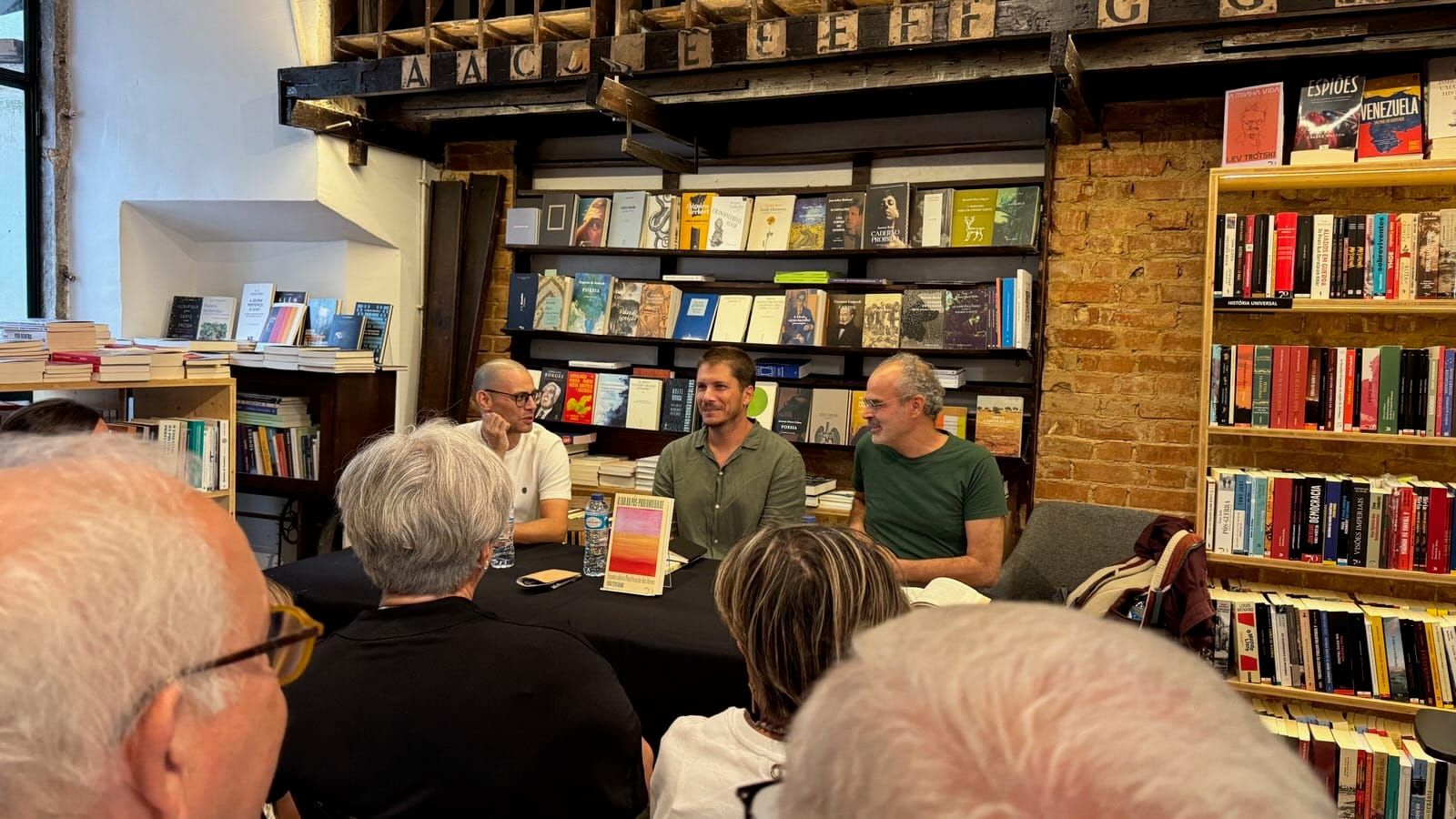
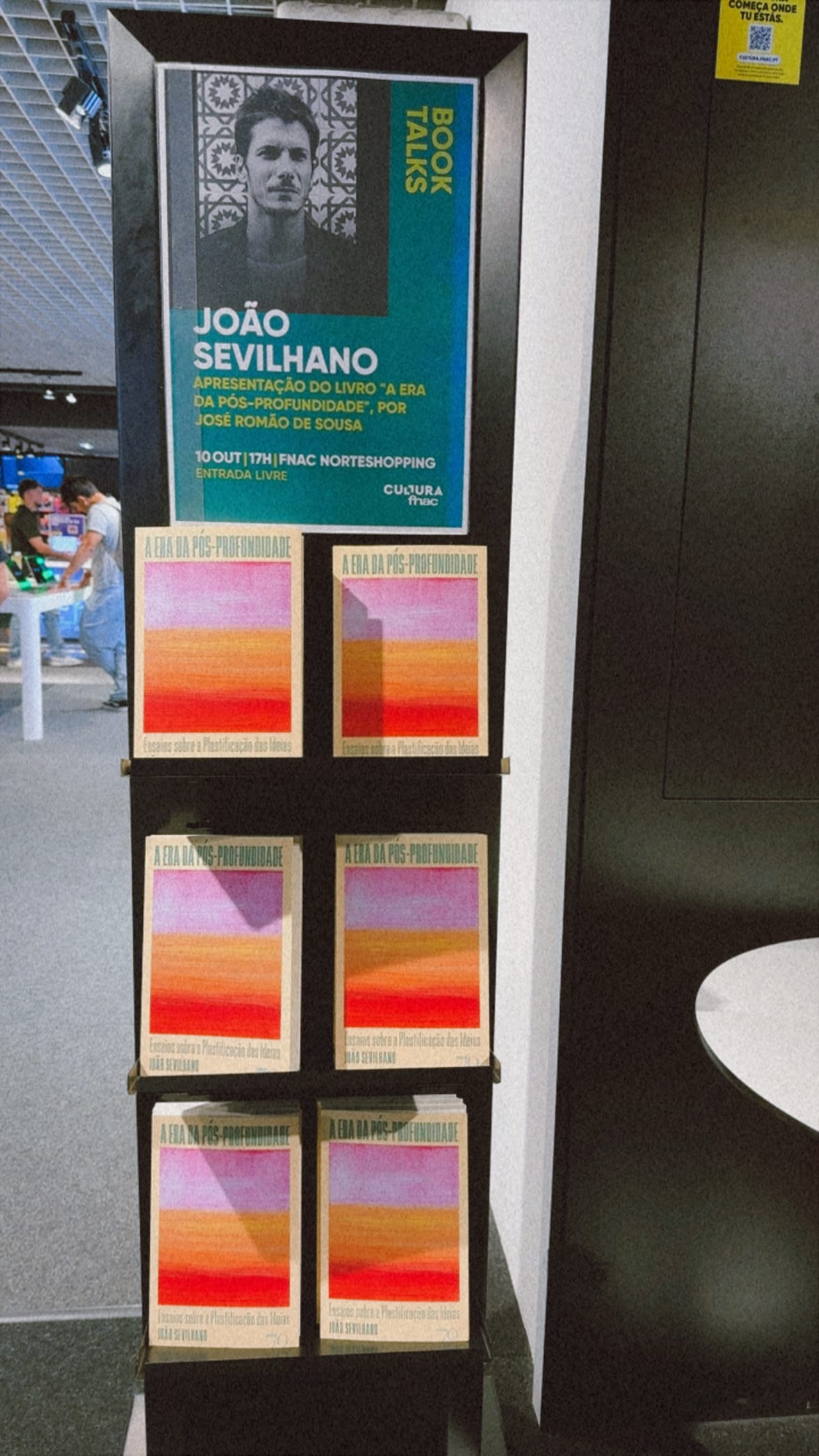
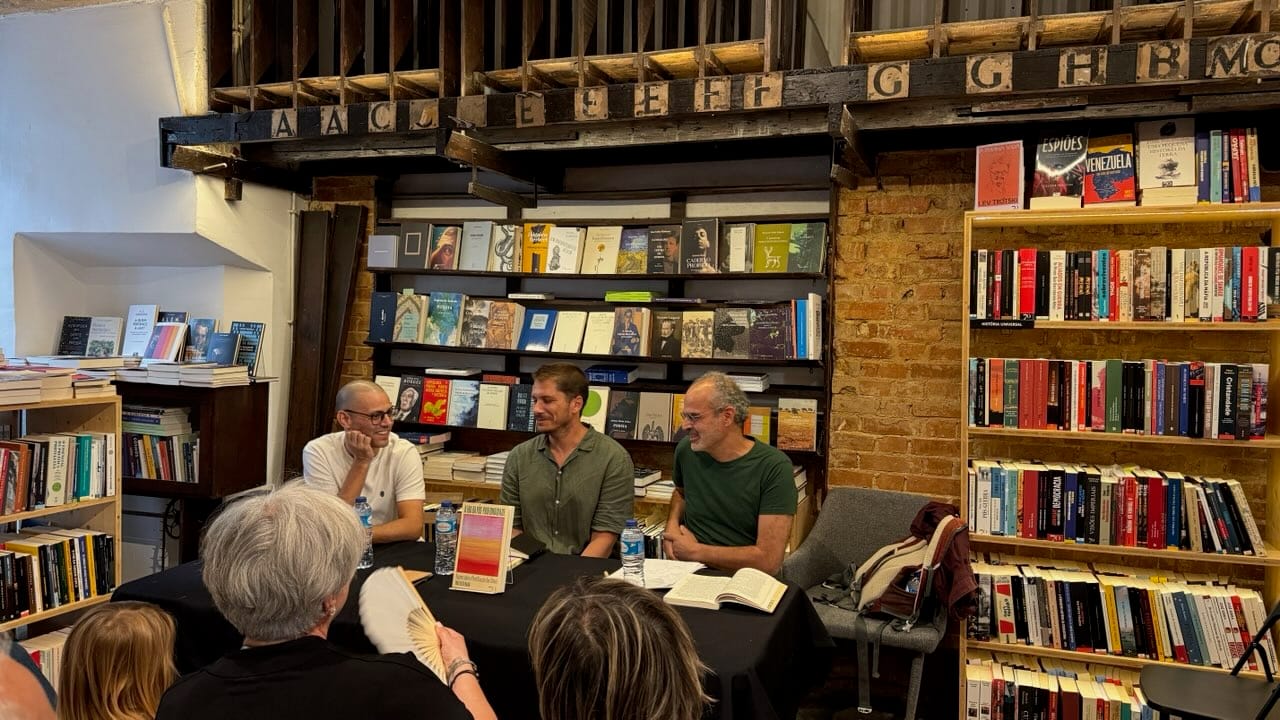
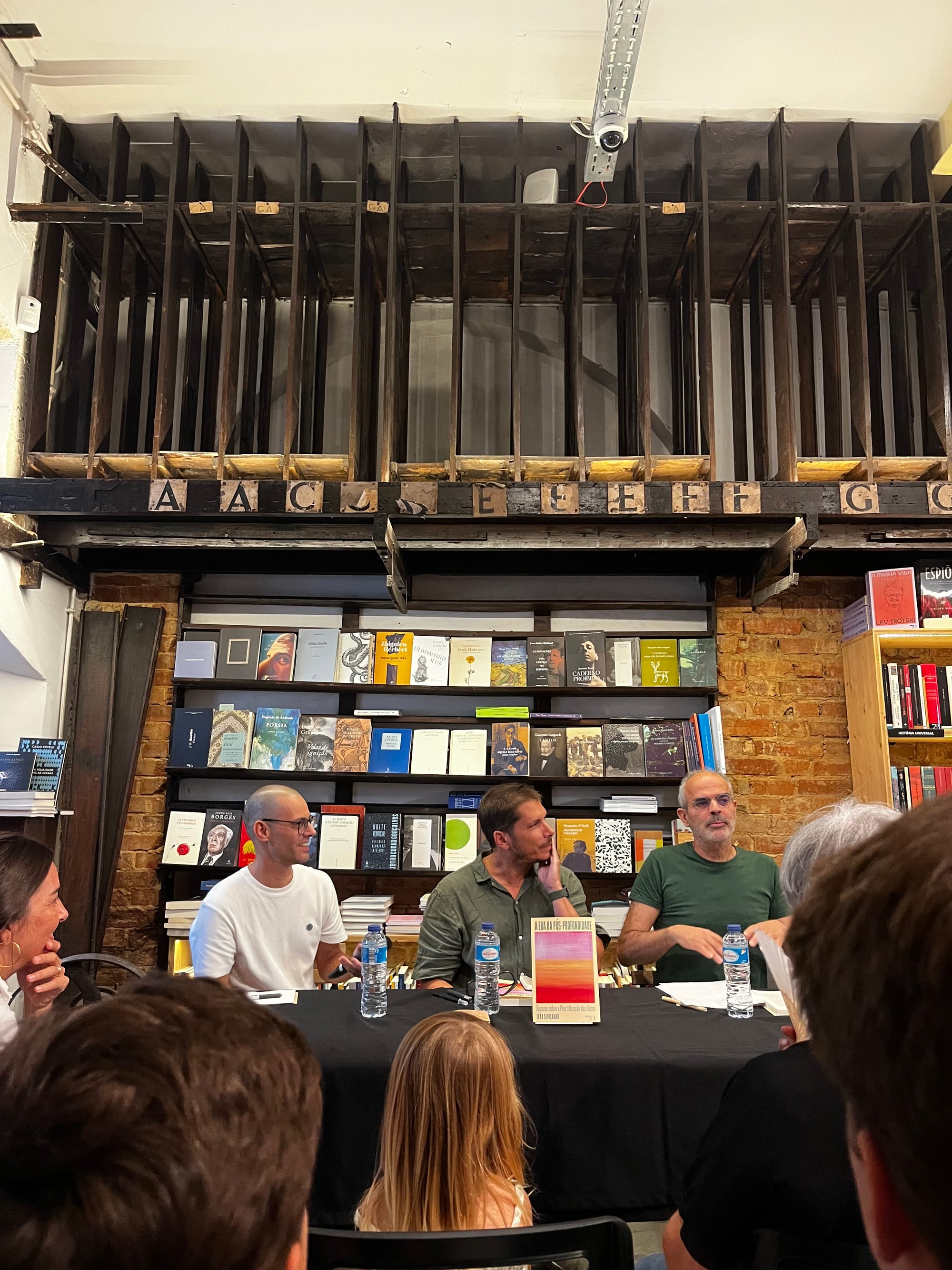
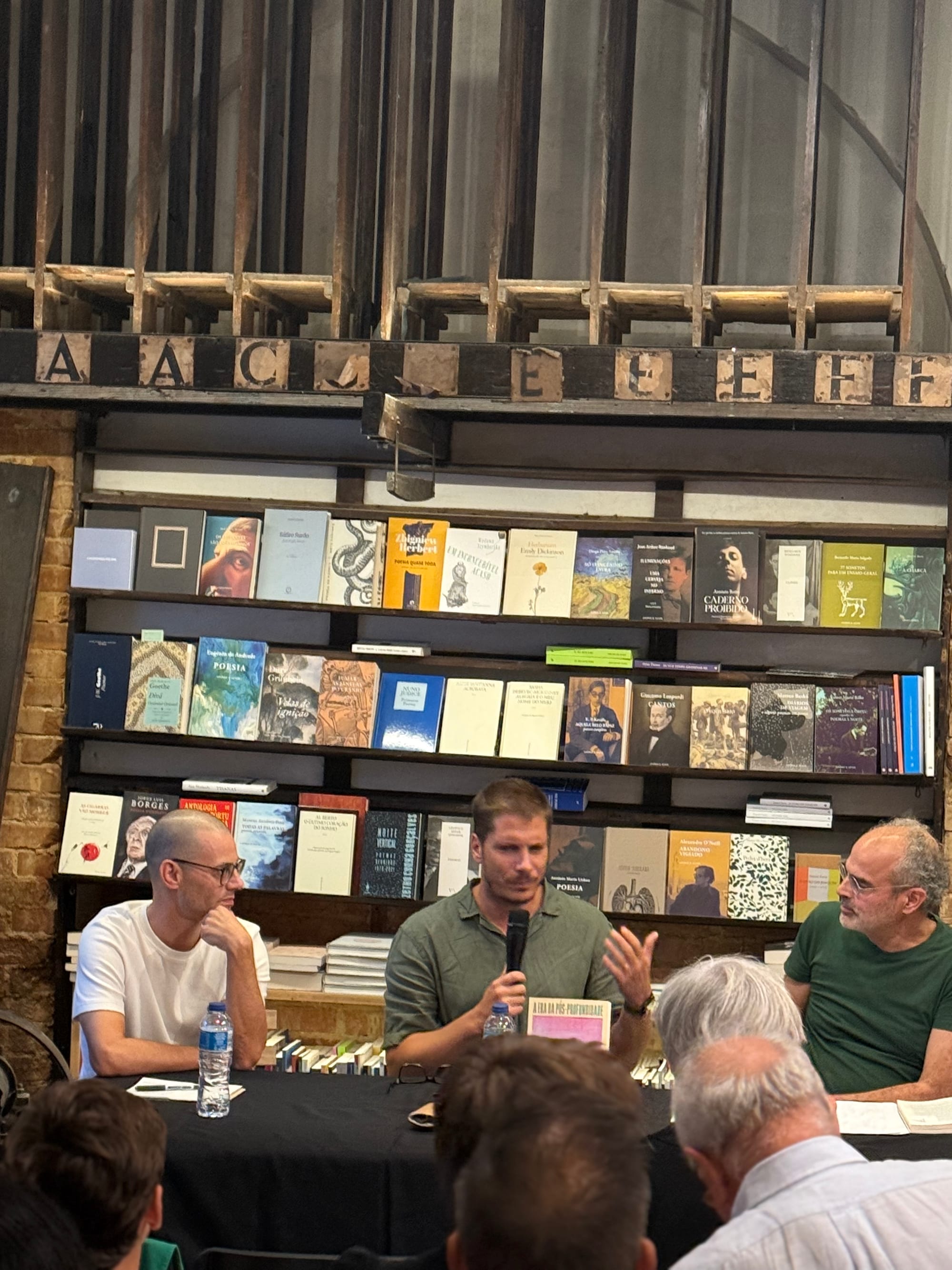
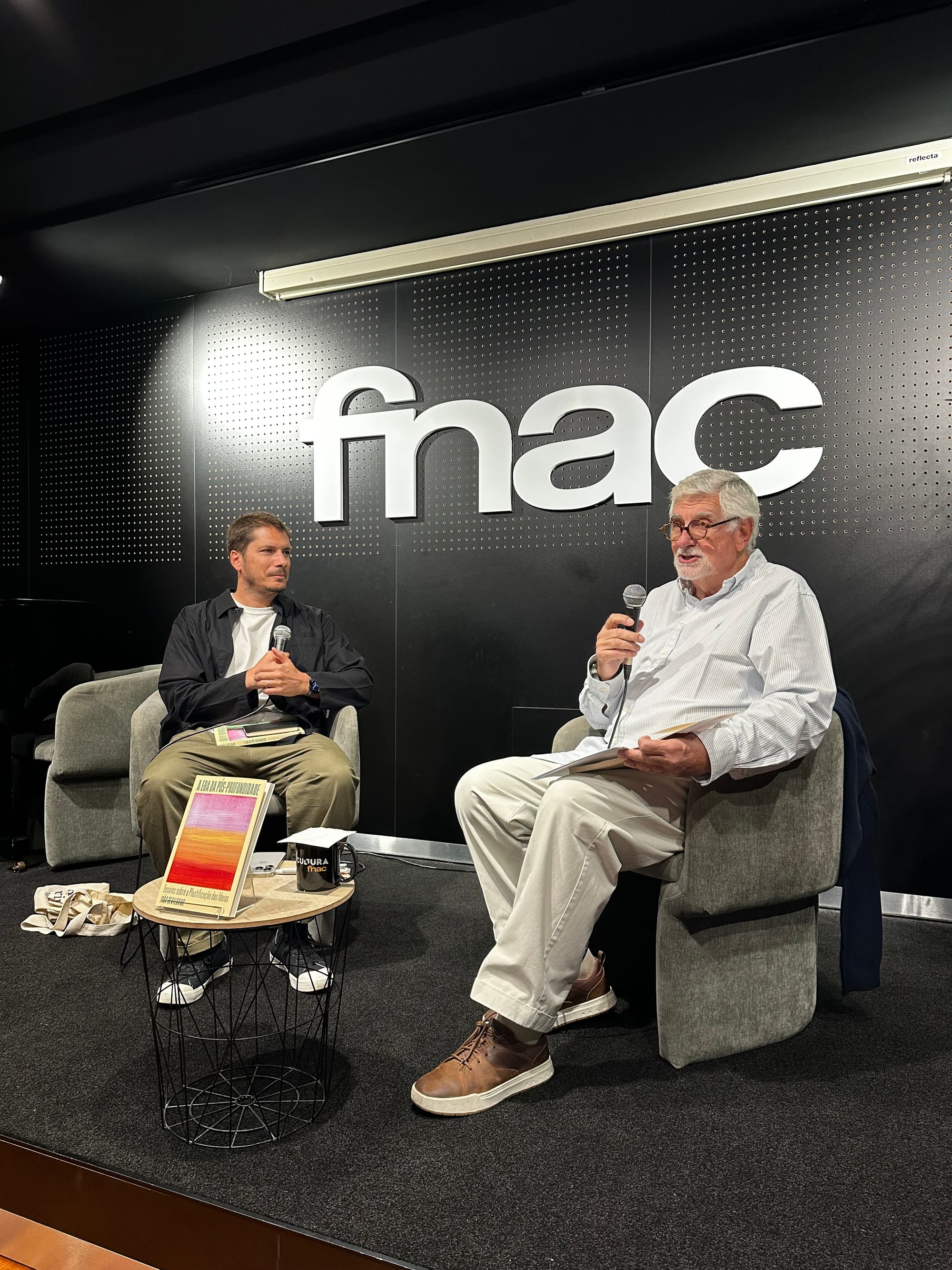
On Saturday, at a Fnac in Porto, José Romão de Sousa told me, microphone in one hand and the book in the other, that I am as lost today as I was ten years ago. He has known my parents for forty-two years; he is allowed. I said yes, with one difference: I am no longer angry, I am worried, and I now have better words for it. I had said much the same to a newspaper, and it had come out in print the day before, still without those words. The sentence travelled from Lisbon to Porto and improved on the way. That is what happened to the book in those eight days.
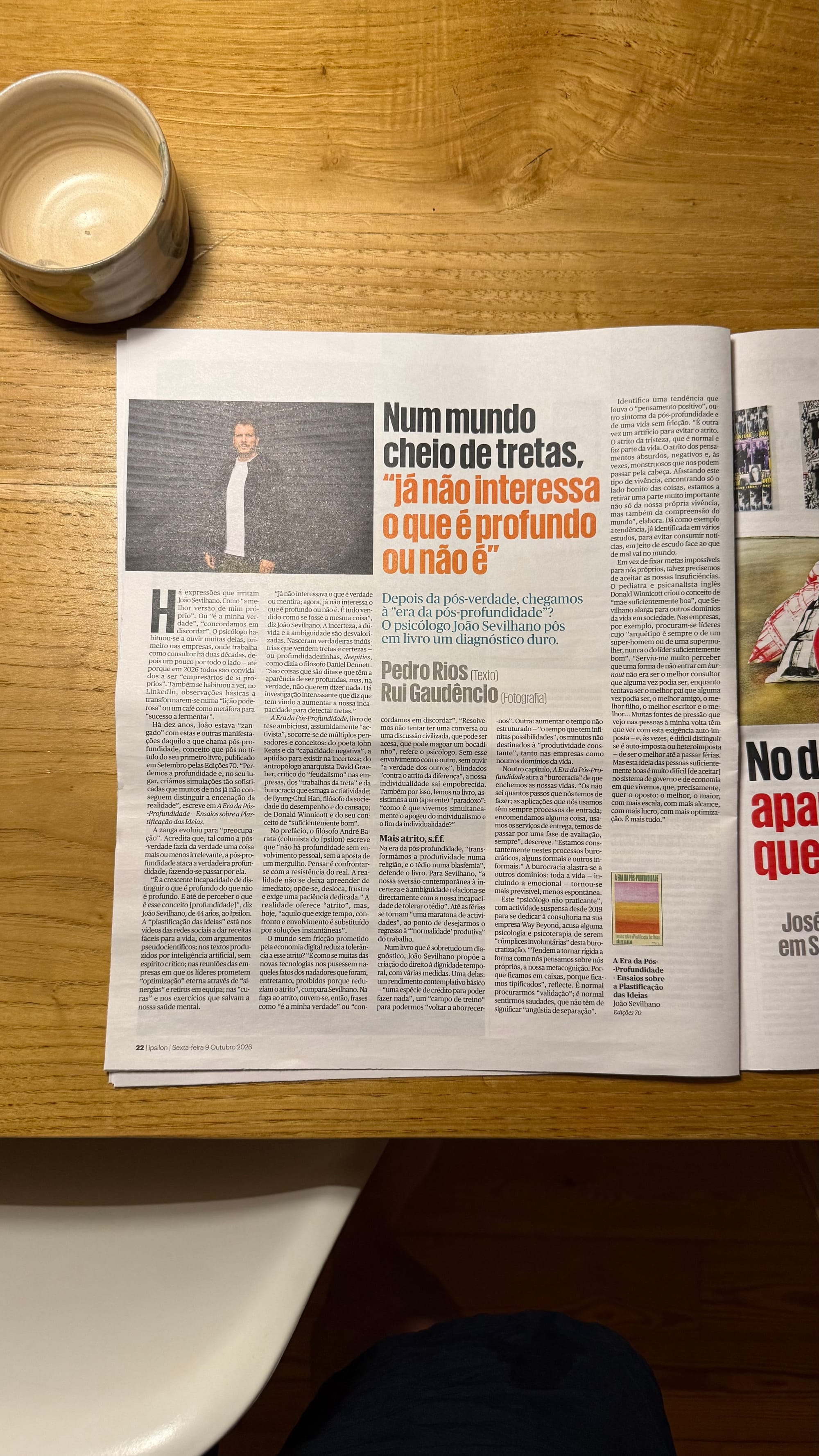
Some context for readers outside Portugal. A Era da Pós-Profundidade came out in September, in Portuguese, and in the first half of October it went out in public four times: an hour live on Prova Oral, a talk show on Antena 3, one of the stations of the Portuguese public broadcaster; an interview in Ípsilon, the culture supplement of the daily Público; and two launch sessions, one in Lisbon with the novelist Gonçalo M. Tavares, one in Porto with José. Writing this helps me think about what happened, because while it was happening I had no time to.
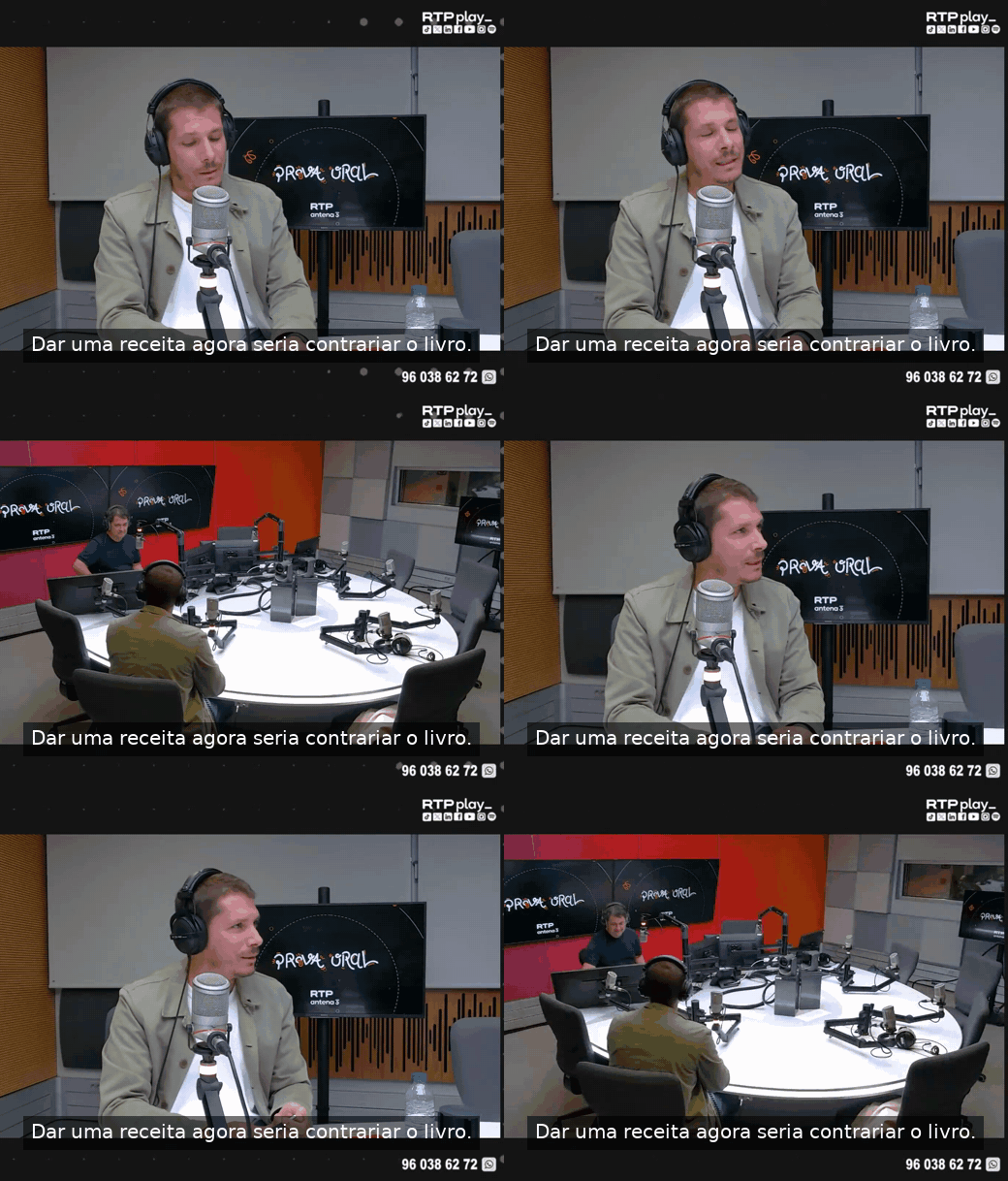
the radio
The host, Fernando Alvim, opened by saying he had started the book “hungry” and wanted to prove its title wrong. What I kept were the listeners’ messages. Helena makes one-minute videos and had gone to watch an old interview, in black and white. The slowness of the questions and the answers irritated her, and then it worried her that she had been irritated. I answered with cartoons, the ones of my childhood against the ones of today: the speed of the cuts, the length of the dialogue. Her question stayed unanswered: where is this taking us? Filipa defined bullshit as talking past: “a conversation that isn’t a conversation, it’s a monologue”. I had written a book on the subject and had nothing to add. Alvim signed off hoping the programme had been boring enough to leave us curious.
the interview
An interview is the genre in which your words pass through someone else’s hands, and I liked seeing mine in Pedro Rios’s. He stayed with the diagnosis: bullshit, friction, temporal dignity, “good enough”. The hardest part was the camera, pointed at me for so long. I warned the photographer that photographs and I did not get on. “Me neither,” he said.
Friction made it into the piece. Pedro asked whether the frictionless world the digital economy promises lowers our tolerance for friction, and I answered with the image that came to me: new technologies are like those swimsuits that were banned from competition because they reduced drag.1 In the flight from friction you get sentences like “that’s my truth” and “let’s agree to disagree”, ways of not having the conversation, the one that can get heated and hurt a little. The paper made a subheading of it: “More friction, please.”
The book proposes conversation as a way out, and conversation cannot be described in an interview; it has to be had. It took a bookshop and a shop.
lisbon
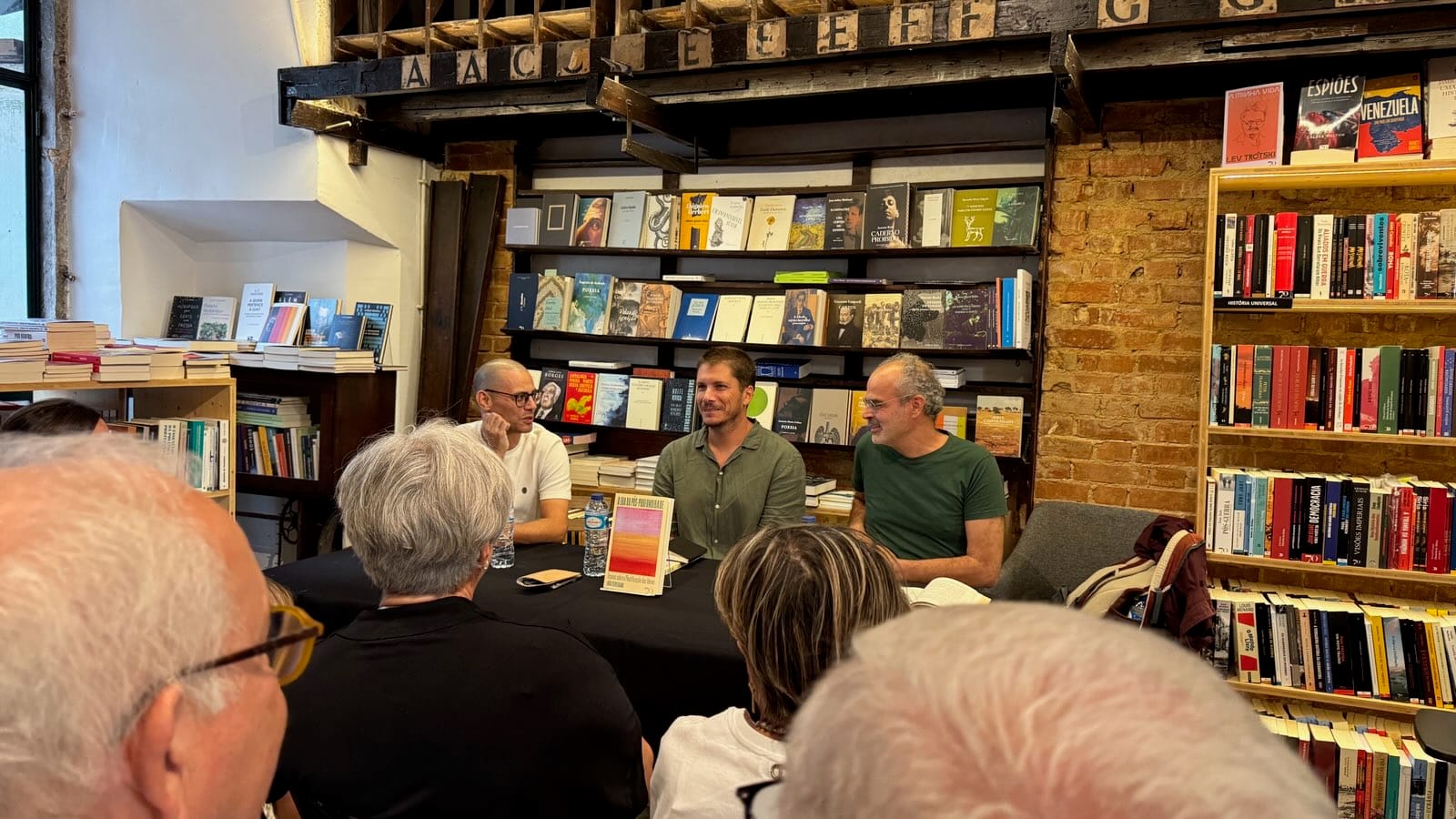
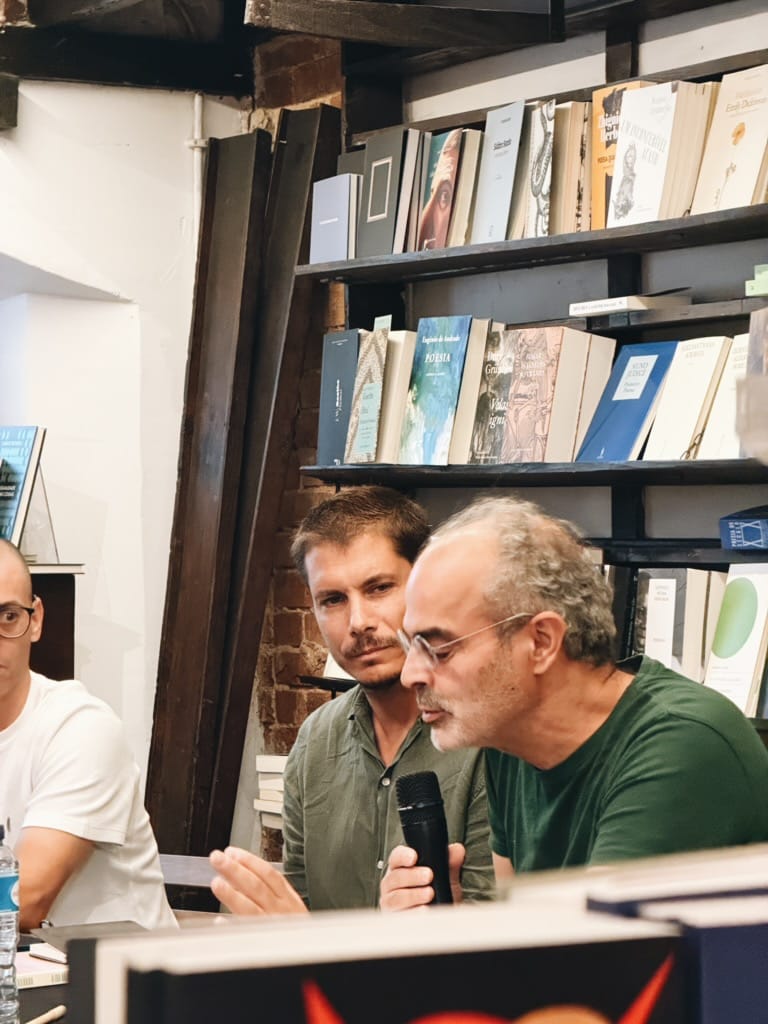
Gonçalo M. Tavares is one of the writers I admire most, and I had to stop reading him while I wrote the book, because every time I read him I start trying to write like him. He warned that he had not finished the book and would speak as a writer, not a critic. He brought it annotated. The first thing he did was change a verb. The preface or speaks of diving; he proposed digging. Diving is going to the bottom of a liquid; digging is going to the bottom of a solid. Surface, he said, belongs to the square kilometre and to speed, the strategy of armies; intelligence proceeds otherwise. From the back of the room, a woman who works in archaeology sent the verb back: for her, digging reveals what is hidden, and death, which I had brought into the conversation, has nothing to do with it. Or does it? Archaeologists dig to learn about people who are no longer alive.
From there he went to those who do not dig. We live in a time of territorial occupation (that is what the wars are), and the movement opposite to digging is wanting to leave the Earth. Musk, he said, has not read an intelligent book in who knows how long, Trump not even a title, and it is Mars they want. My favourite sentence of the night: “people who don’t dig want to fly.”
The rest was about the link between language and thought, which is the ground the book stands on. A repeated phrase is always non-thought, “zero thought”, and turns into a kind of prayer; a party’s talking points are exactly that, the same words in the same order. Since Wittgenstein, he said, we have known that banal language comes from banal thought and probably produces banal action. Language is the visible part of the iceberg: if the words repeat, the thought is stuck on a roundabout. The same went for positive thinking, which he dismissed as an absurdity, and I was glad, because I have never been able to take the expression seriously.2 Thinking is not saying whether something is good or bad; the value judgement, he recalled with Barthes, is the minimal form of subjectivity, that of the baby who likes or does not like.
Friction came back, with a book I did not know, Silvina Rodrigues Lopes’s Literatura, Defesa do Atrito (Literature, a Defence of Friction). The pickaxe hits rock and goes no further; faced with an equation or a difficult philosopher, most people run away, put the pickaxe down or curse the ground. He quoted Barthes again: when I don’t understand something, I am the stupid one. And he left a note for schools, with children in the room listening: one of the silly things schools do is remove every little bit of friction from in front of the pupils, when that is exactly where curiosity starts.
The moment the bullshit turned against me came from very close by. Inês, my wife, who was in the front row, works in a transplant unit. She said that often, before leaving, she walks through the ward for no reason: she sits down, says she is tired, talks about football and who is going to win, half an hour of conversation with no content. One day a patient told her: “You have no idea how much this matters, you just sitting here talking with us.” Gonçalo took the cue. Bullshit has power too, he said, and its power is affective. He recalled Barthes, for whom a repeated “I love you” is no longer language: it is a touch of skin. And then: “Language is also a form of hospitality.”
I tried to answer at the time and can only write the answer now. The trouble with bullshit begins when it does not own up to being surface and tries to pass for something else; that is what I call post-depth. Surface that owns up to being surface allows contact, and good. That is just called living with other people.
It was my editor at Edições 70, João Moita, who gave the title its strongest image. The book is not called the age of superficiality; it is called the age of post-depth. Benjamin comments on Baudelaire’s prose poem in which the poet loses his halo in the mud of the boulevard and is relieved, anonymous, free to walk the city and tell what he sees. Today it is the other way round: it was not the poet who lost the halo, “the halo is what lost its depth”. We want it shiny, polished, and we do without what justified it. Hence the clichés, “the best version of myself” at the head of the list.
porto
José is not a literary critic, and said so at the start. Forty years in companies, then fifteen in mental health, in a therapeutic community that works on the Finnish Open Dialogue model. He read the book as someone who has lived what is in it, so his questions came with stories. On “good enough” he told the story of his school years: national exams at twelve, fifteen and seventeen, exemption with an average of fourteen out of twenty,3 and with it four months of summer holiday. “My aim was never to be the best in the class, it was to be good enough not to sit the exam.” On doing nothing he made a confession: he learned to enjoy it only a few years ago, “something that had never crossed my mind”. I grew up being told I was an old soul and never quite knew what it meant. Perhaps it was this. When there is nothing to do, there is everything.
My own story was the pause button. My sons arguing because one needed the bathroom and the others would not pause the television. When I was a boy there were two or three channels and cartoons had a time; needing the bathroom was an internal conflict, settled between me and me. Now the conflict moves outside, and it is with the brothers. I do not know whether this is a loss.4 I know it has moved the place where frustration gets resolved, and I fear the move is leaving us less able to think.
what stayed open
In Lisbon, Miguel, a former student at the start of his career, asked what incentives could bring depth back to a generation that floats on the surface “like buoys, full of armbands”. I told him I want to know too, that I have children and am learning, and that the book is one more step in that search. In Porto, José challenged me to write a book of solutions. I declined, for now: I am better at criticising, and the solutions I find would sound utopian. He asked about the next book and I said I don’t know, and that I am making myself not know yet.
Gonçalo said at one point that “we are badly short of conversations with no purpose”. That is what the two sessions were. In the days before Lisbon, after learning he had accepted, I dreamed of that room: we were sitting at the table, Gonçalo with the book open and a pencil, crossing out sentences and saying “no”. On the Thursday he brought the book and his notes, and when I peeked there were no crossings-out. Phew.
The next conversation is across the river from Porto, on Sunday 8 November at 5 pm, at the Fnac in Gaia, with the philosopher Sofia Miguens, who publishes with the same house. If you read Portuguese, her Uma Leitura da Filosofia Contemporânea is where to start, and episode 88 of the podcast 45 Graus is where to hear her.
- The full-body polyurethane suits of 2008–09, the Speedo LZR Racer the best known. FINA voted to ban them in Rome in July 2009, with effect from January 2010; the complaint was buoyancy and compression as much as drag. ↩︎
- My own case against it is older than the book: “the positive effects of negative thinking”. ↩︎
- Portuguese schools grade from 0 to 20, with 10 as the pass mark. ↩︎
- I told this story before, in “the right to temporal dignity”, and drew a firmer conclusion from it: that the external fix atrophies the internal capacity. I am less sure of it now. ↩︎
This is a reader supported publication. If you enjoy the content, please consider a paid subscription or a donation. Also, if you thought of someone while reading the content, don’t hesitate to share it with them.