

I have written about attention and certainty. But I felt something was lacking, and, although I enjoy my critical facet, bearing in mind some feedback I received along the way, there were some paragraphs I had written last June (2025) I felt could have the potential to become a piece that would move more on the exploration side than on my habitual critical observation tone. Maybe I’m trying to pass on an image of someone who is not only gray — despite being one of my favorite colors —, cynical or negative, whatever that might mean.
The future isn’t always frightening or anxiety-inducing. Not knowing what happens next is often precisely what captures our attention, what keeps us engaged. When we watch a football match that excites us, it’s the uncertainty about the outcome that maintains our attention and expectation, even when it ends in a goalless draw or, worse, our team’s defeat.
In this spirit, I decided to write about “enthusiasm”. Particularly, the enthusiastic kick that emerges when we don’t know what happens next. Watch children listening to a story they’ve never heard. Watch surfers immediately after dropping in on a wave. Watch yourself in the first minutes of a film that might be terrible or transcendent. It’s aliveness; a particular kind of attention, or a potent enough distraction from your previous state. The body leans forward. Time changes texture. Yet, we don’t call it “discomfort”. It’s a different feeling. Some call it anxiety, but it’s not the same that we attribute negative aspects to. It’s something in us that is awakened that no amount of certainty can rouse.
the physics of anticipation
Imagine if we could edit a match in advance—add three goals here, guarantee a dramatic save there, ensure our team wins. In theory, we’d be adding spectacle. In practice, we’d be destroying the only thing that matters: the not-knowing that keeps us watching. If we could introduce alterations, editing the result beforehand, we’d substantially diminish, or even entirely remove, all interest in watching.
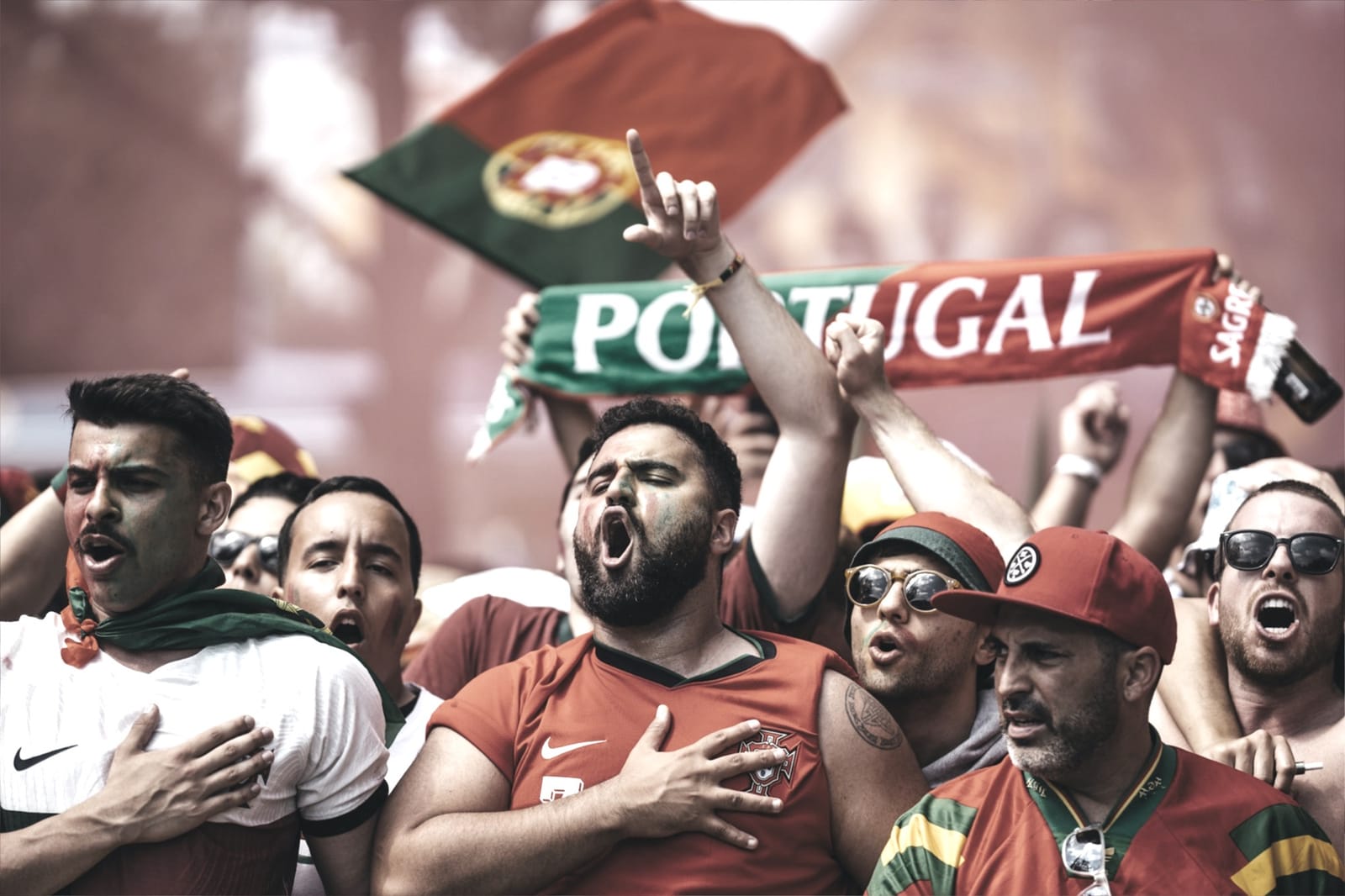
I remember the 2016 Euro final. Portugal in Paris, facing France at home. We’d drawn every group match—three draws, qualified as one of the best third-placed teams. The newspapers called us lucky (we were!). The odds were against us. France and Germany had always got the best of Portugal in crucial matches. Then, twenty-five minutes in, Ronaldo went down. Our captain, our talisman, carried off on a stretcher in tears, minutes after a moth strangely landing on his face. It felt like the whole country went silent. Not the disappointed silence of a missed goal but the stunned silence of watching hope leave on a stretcher.
What happened next was extraordinary. Not the victory—though Éder scoring in the 109th minute from twenty-five yards out was absurd enough—but the quality of attention one could feel in the air. Without Ronaldo, without our certainty, we became something else. Every touch mattered differently. Every player was suddenly possible. When Éder, who’d failed to score in fifteen matches for Swansea, picked up the ball outside the box, nobody shouted “shoot.” But nobody looked away either.
When it went in, the explosion wasn’t just joy. It was the physical release of ninety minutes of impossibility suddenly becoming possible. We’d won our first major tournament with three draws in the group stage and our best player injured. The enthusiasm wasn’t for the victory but for the proof that the future could still surprise us.
The Portuguese have a word, ansiedade, that we translate as anxiety but that carries within it the root ânsia—yearning, eagerness. There’s positive yearning and negative yearning. That night in Paris, we lived in the space between them.
the paradox of prediction
The same principle applies everywhere attention naturally gathers. Films that surprise us hold us captive. Books that keep twisting our expectations get devoured. Music that goes where we don’t expect stops us mid-step. The artistic works that grab us are those that confound our expectations, that make us doubt the outcome or even the next moment, even when the twists happen only in the realm of ideas and individual feelings.
Even those who pride themselves on predicting endings—those show-offs who announce plot twists before they happen—see their smugness replaced by boredom when they’re right. They have to endure the rest of the story unfolding exactly as they imagined. Even the vainest of these prophets, who sustain their enthusiasm by continuously self-congratulating their deductive abilities, will probably rate the story less favorably precisely because it failed to surprise them. More times I’m comfortable to admit, I’m that person.
makers and gamblers
Talk to anyone making something genuinely new—not iterating, not optimizing, but creating—and you’ll find this same quality. They’re nervous and excited in equal measure. They can’t sleep but don’t want to. They talk too fast, draw on napkins, lose track of time, especially while trying to convey to others what’s on their mind.
This is different from gambling addiction or adrenaline seeking. The enthusiasm isn’t for risk itself but for possibility. The sculptor looking at a stone, the writer facing a blank page, the conversationalist waiting for the perfect time to introduce a great argument, isn’t hoping for random outcomes—they’re engaged with a process where their skill meets forces beyond their control. The enthusiasm lives in that meeting point.
the conversations that matter
The best conversations I’ve ever had shared this quality. Nobody knew where they were going or, if someone had an initial idea, they were available to lose it. Someone would start a sentence and discover their thought halfway through. Ideas would emerge that nobody brought to the table. Hours would pass unnoticed.
Try to recreate these conversations and they die. Schedule them, assign topics, set outcomes—you might get information transfer, but you won’t get that particular fire. The enthusiasm wasn’t for the content but for the discovery, for finding out what we thought by hearing ourselves say it.
This is why first dates can be electric and anniversaries awkward. Why startup founders glow (trying not to burn) and corporate executives gray. Why children’s questions devastate us with their brightness while adult small talk feels like death.
when work works
I’ve seen this enthusiasm in unexpected places. An engineer friend describes certain processes—the complex ones, the uncertain ones—as “swimming in possibility.” When I teach, I often observe the moment when a struggling student suddenly understands something, but more importantly, the moments before, when understanding hovers just out of reach for both of us. It’s like we’re exploring together for something neither has seen yet.
Even in supposedly routine work, uncertainty creates pockets of life. I often get this when working in 1-on-1 settings. I confess that I have phases when I don’t believe that every person is singular. This is not constant but even in those phases, there’s that particular session, or moment, when I’m caught off guard; when my dullness is interrupted by curiosity. The regular conversations, I could do them like drinking water. But when someone poses or is an unforeseen challenge—that wakes me up.
the tempo of not knowing
Enthusiasm has its own chronology. It elongates certain moments and compresses others. Watch someone opening a gift, reading test results, watching microwave or oven timers, waiting for a response to “I love you.” Time becomes sculptural, shapeable. Five seconds can feel like five minutes, but five hours can vanish.
This is why predictable schedules feel so deadening. Not because routine is inherently bad, but because when we know exactly what happens next, time loses its texture. Monday becomes Tuesday becomes Wednesday without distinction. The weeks accelerate even as the days drag.
But insert genuine uncertainty—a project without a clear path, a problem without a known solution, a conversation without a script—and suddenly we’re in time rather than watching it pass. Uncertainty is novelty, in those situations.
abundance, not scarcity
The beautiful thing about uncertainty is its inexhaustibility. But this characteristic is only visible if one intentionally stops performing certainty. If willing, we can’t run out of things we don’t know. Every answered question can generate new questions. Every mastered skill reveals new incompetence. Every solved problem uncovers problems we didn’t know existed.
Children understand this intuitively. They’re enthusiastic about everything because everything is uncertain and mostly unknown. How does the toaster know when the bread is done? What do cats think about? Why is water wet? They’re not seeking answers to close questions but to open worlds.
We lose this not because we gain knowledge but because we pretend to. We perform certainty until we believe our own performance. The enthusiasm doesn’t die—we bury it under layers of false knowing, of perceived need for certainty and the comfort of control.
returning to the game
I’ve been playing chess with my boys. I’m not teaching them, as I’m learning as well. We all know the rules but no one considers themselves good players. We know there are written strategies, openings, closings and such, but we’re not familiar with any of them. Each revealed win or trick is a small delight. “Oh, so that’s why you did that!” The game was secondary to the revelation of the game. I learned I love being outgamed by my kids. I love the feeling of not seeing a particular move they planned. I also love to outsmart them, but that’s what’s expected. It’s not as fun as being caught distracted or trapped in my own arrogance.
This is the enthusiasm I’m talking about. Not the cheap thrill of winning or losing, but the deeper pleasure of engaging with unfolding possibility. Of being genuinely surprised by what happens next, even—especially—when we’re participants in making it happen.
The future isn’t something we predict or prevent. It’s something we meet. And in that meeting, in that not-knowing-yet-engaging, lives an enthusiasm that no amount of certainty can match.
We don’t watch the game because we love our team, though we tell ourselves that story. We watch because we love the watching, the not-knowing, the collective lean into whatever happens next. We love being reminded that the world exceeds our comprehension, that surprise remains possible, that life is still happening.
The enthusiasm isn’t despite the uncertainty. The enthusiasm is the uncertainty, experienced from the inside, with our whole bodies, together.
This essay explores what “The Certainty Syndrome” only implied: that our attempts to eliminate uncertainty aren’t just futile but tragic, because uncertainty is the source of the very enthusiasm that makes experience worth having.
This is a reader supported publication. If you enjoy the content, please consider a paid subscription or a donation. Also, if you thought of someone while reading the content, don’t hesitate to share it with them.