

Merriam-Webster chose “slop” as its 2025 word of the year. The definition: “digital content of low quality that is produced usually in quantity by means of artificial intelligence.” The dictionary’s editors noted that the word shares “the wet sound of something you don’t want to touch” with its linguistic cousins—slime, sludge, muck. It oozes.
I’ve not been thinking much about slop, but current events have sparked some curiosity about it. So, I dug a bit to see if curiosity would lead to an association. Here it is.
the archaeology of a word
By now, if you’re a recurrent reader, you may have intuited my love for words and their origin stories. Words carry their histories in their bones. “Slop” descends from the Proto-Indo-European *sleubh-—to slip, to slide. The same root gave us sleeve (where the arm slides through) and lubricate.[1] From the beginning, slop has meant instability. Loss of solid ground.
In Middle English, sloppe was a mudhole. The Old English cusloppe—literally “cow dung”—tells us where the word lived: in the farmyard, among excrement. The cowslip flower takes its name from where it grew.[2]
By the seventeenth century, slop had moved indoors. It came to mean semi-liquid food of poor quality—the undifferentiated slurry of kitchen scraps, vegetable peelings, whey, and washing water that farmers collected to feed the pigs. The trough became a site of consumption without discrimination. Everything went in. Everything got eaten. The pig didn’t choose. The pig couldn’t choose. The nature of slop is that discrimination becomes impossible—one cannot pick out the carrot peel from the dishwater, the edible from the waste. It arrives as is.
The nineteenth century added household wastewater, including the contents of chamber pots. In British prisons, “slopping out” was the morning ritual of inmates emptying their buckets of waste.[3] The word accumulated toxicity alongside viscosity. It named what we produce and would rather not see. What accumulates in the night and must be dealt with in the morning.
And here’s a detail I find telling: already in 1866, “slop” described cheap sentimental culture—writing or music excessively mawkish (I learned this word in English, that I didn’t know existed, as the literal translation of the Portuguese piegas), a porridge of clichés.[4] Victorian critics were using the word as we use it now, for content that simulates emotion while producing kitsch. The gesture toward feeling without the feeling itself—this could be an alternative way to define post-profundity. The AI didn’t invent slop. It industrialised its production.
Linguists observe that the phonetic structure contributes to the word’s effectiveness. The initial /sl-/ belongs to a family of English words associated with slipperiness and loss of control: slime, sludge, slug, slush, slob—many carrying additional connotations of wetness or negative affect. The British linguist J. R. Firth called these patterns “phonesthemes”—sound clusters that carry meaning beyond their constituent parts.[5] The terminal /p/ suggests something soft hitting a surface. The word sounds like waste falling into a bucket. You hear the plop.
before the algorithm
I should confess something, with no intention to signal virtue or superiority: I’ve watched very little reality television. What I know comes from fragments, references, the cultural osmosis that makes avoidance impossible. This distance may be prejudice. It’s certainly limitation. What follows is therefore diagnosis from the outside—which may be its own form of slop: confident pronouncements about phenomena I’ve barely witnessed.
What I can say is this. I don’t believe professional wrestling is unscripted combat, but I recognise the athleticism, the choreography, the genuine physical risk. There’s craft there, even if outcomes are somewhat predetermined. I struggle to extend the same generosity to reality television—a format that claims the name “reality” while manufacturing situations, editing responses, constructing narratives that bear little resemblance to how people behave when cameras aren’t rolling.
In 2011, the Portuguese comedian Bruno Nogueira created Último a Sair for RTP—a parody of Big Brother so convincing that many viewers, even now, remain uncertain whether it was satire or the genuine article. The promotional campaign deliberately obscured the programme’s nature, advertising it as a real reality show before the first episode aired. The actors followed scripts but improvised liberally. They were so convincing in their banality that audiences couldn’t tell the difference. Or were we, the audience, already in a state of torpor that could not distinguish reality from fiction?
This says something troubling about the original format. When satire is indistinguishable from its target, what exactly is being satirised? The answer, I think, is that there’s nothing left to exaggerate. The original has already consumed all available absurdity.
For readers outside Portugal: imagine a mockumentary so perfectly executed that significant portions of the audience took it at face value—not because they were stupid (I think or wish…) but because the original was already so absurd that exaggeration became invisible. The programme remains available on RTP Play. Recently, some clips made it to Brazil and Portuguese-speaking African countries, and there was backlash because people who hadn’t seen it before felt some of its content to be offensive—a sign of the politically correct infused era that we live in.
Calling this genre “reality” does something to reality itself. It erodes the distinction between what happens and what is produced. And this erosion prepared us for what followed. Reality television taught us that entertainment need not be entertaining in any meaningful sense. It simply had to occupy attention. I think it’s no coincidence that Donald Trump hosted a reality show, and that his presidency, at least for a Portuguese living in Portugal, evokes that same feeling. The transition to mindless scrolling was seamless. Where reality TV offered scheduled emptiness at predetermined hours, social media delivered it continuously, on demand, infinitely customised to our particular flavour of empty calories.[6]
Byung-Chul Han writes about the “tiredness society”—the exhaustion that comes from perpetual self-optimisation, from the demand to be always performing, always productive, always “on.” There’s a nutritional equivalent to this exhaustion. We consume without being nourished. We scroll without being informed. We engage without connecting. You can spend forty-five minutes on your phone and remember nothing of what you saw—only the vague sense that time has passed and something has been lost. The tiredness Han describes isn’t the fatigue that follows meaningful labour. It’s the depletion that comes from activity without purpose, consumption without sustenance. We’re full and starving at the same time.
why we swallow it
The question that interests me isn’t why slop exists. Of course it exists. Production costs approach zero (if we discard the amounts of energy needed to feed the AI systems that produce a big chunk of it). Distribution is instant. Algorithms optimise for engagement, not quality. The economics are obvious.
The question is why we tolerate it. Why we seek it out. Why we keep scrolling through content we know to be worthless.
Part of the answer lies in what I’ve called post-depth: the creation of such sophisticated simulations of profundity that many can no longer distinguish performance from substance. When “vulnerability” becomes a personal brand and “authenticity” a marketing strategy, slop becomes indistinguishable from sincerity.
The mechanisms that produce AI-generated prawns-fused-with-Jesus also produce the endless parade of self-help platitudes, life-hacks, and inspirational quotes that constitute our era’s spiritual wallpaper. The aesthetic is identical. The epistemic status is identical. Both simulate meaning while producing only its residue.
The rhetorical strategies of post-depth bear uncomfortable resemblance to populist argumentation. Both reduce complexity to slogans. Both appeal to immediate emotional response over sustained analysis. Both present themselves as liberating while constraining thought. The populist promises simple solutions to complex problems. The post-depth practitioner promises simple transformations for complex beings. The slop-producer promises entertainment without the friction of engagement.
The same rot that produces AI slop produces political slop—claims so detached from verifiable reality that they function not as statements to be evaluated but as performances to be witnessed. “That’s my truth” and “alternative facts” emerge from the same mud.
the erosion of discrimination
This erosion—of critical capacity, of the ability to distinguish substance from simulation—doesn’t stay contained. The pig at the trough doesn’t distinguish what it eats. It can’t. It eats what’s there. Decades of reality television, social media, and algorithmically-optimised content have done something similar to us. We no longer notice the absence of substance. The erosion of critical thinking in one domain—entertainment—prepared its erosion in others. Politics. Ethics. Epistemology itself.
I’ve written about the certainty syndrome: we’ve become certain that nothing is certain, sure that truth is whatever we feel it to be, confident that confidence alone constitutes argument. In this environment, slop thrives. When all claims are equally valid, the lowest-quality claims win through volume. The trough overflows. We keep eating.
This degradation of discrimination is what connects our tolerance for AI-generated rubbish to our tolerance for political rubbish. The capacity to evaluate—to judge, to discern—atrophies when it isn’t exercised. And we’ve been training ourselves, through millions of daily interactions with worthless content, not to exercise it.
the politics of slop
I’ve tried to keep this publication apolitical. Not from indifference—from conviction that my role isn’t to align readers with particular ideological positions. My interest lies in rigorous (and deep, and broad) thinking, in holding space for diverse perspectives, in believing that genuine plurality might find better paths for more people. I consciously and with effort include myself in this equation.
But now I confess the impossibility of the apolitical stance. It was always impossible. Every silence is a speech act. Every omission is a choice. The pretence of neutrality is itself a political position—typically one that serves existing arrangements.
What compels this confession is the news from Venezuela. As I write, the United States has completed what it calls a “large-scale strike” on Caracas, captured Venezuela’s president, and declared it will “run the country” while American oil companies “spend billions of dollars” to “fix the badly broken infrastructure.” The President states that “we’re going to get the oil flowing the way it should be.” The Defence Secretary characterises this as “the exact opposite” of Iraq because—I quote—“we spent decades and decades and purchased in blood, and got nothing economically in return, and President Trump flips the script.”
The script being flipped, apparently, is the pretence that invasions are about anything other than resources. The quiet part has become the loud part.
What distinguishes this from Russia’s invasion of Ukraine? From China’s ambitions regarding Taiwan? Each invading power tells a story about historical grievances, about protecting its people, about restoring what was rightfully theirs. Russia claims Ukraine was always part of its civilisational sphere. China claims Taiwan as a province temporarily separated. The United States claims Venezuelan oil was “stolen” when the country nationalised its own resources in 1976. I’m far from a geopolitical expert. I can’t even be considered knowledgeable. And if there’s a thing I’ve been learning in life is that I don’t have to express my opinions about everything because some of them have no legitimacy, are not grounded in enough or are simply poorly constructed. But it’s not hard to identify some patterns here.
The formula is consistent: construct a narrative of victimhood, assert ownership over what belongs to others, deploy overwhelming force, present it as liberation. The difference lies not in the logic but in who wields it—and whose slop we’ve been trained to swallow.
What strikes me is not that politicians lie. This is ancient news. What strikes me is the variety of techniques and their convergent effects. Trump’s approach is brazen: say the false thing or the absurd “truth” loudly, repeatedly, without embarrassment, until the sheer audacity creates its own authority. Putin’s approach is opposite: deny endlessly, dissimulate infinitely, generate such clouds of alternative narratives that truth becomes impossible to locate. One floods the zone with shamelessness. The other floods it with confusion. Both produce the same result: a public increasingly incapable of discerning, judging, acting.
There’s a scene in Interstellar where the protagonists discuss how honest they should be with each other. One of them asks TARS—a robot with an advanced AI—what its honesty setting is. It answers 90%, because that’s what humans are able to discern. The joke lands because we recognise ourselves. We don’t actually want complete honesty. We want enough truth to function, enough deception to remain comfortable. And it’s good that we possess an intransmissible intimacy. In the recent edition of the House of Beautiful Business newsletter, Roger Berkowitz states that “depth requires secrecy.” And, let’s face it, if our raw thoughts went public we wouldn’t be social animals.
The question our era poses is whether we’ve dropped that parameter too low. Whether 40% or 30% or 20% has become our operating norm. Whether we’ve lost the capacity to notice.
how do you say “slop” in portuguese?
Translating “slop” into Portuguese fragments the concept across several domains. English gives us a single viscous word. Portuguese offers choices, each with different weight.
For European Portuguese, the options carry different resonances, and I find them more interesting precisely because they reveal how Portuguese speakers conceptualise waste differently from English speakers.
Lavagem is the literal translation of pigswill—water from washing dishes and floors, traditionally saved to feed the pigs. But “lavagem” carries modern associations that add weight: lavagem de dinheiro (money laundering), lavagem cerebral (brainwashing). To call AI content “lavagem” suggests simultaneously that it’s pig food, that it’s fraud, and that it’s designed to manipulate. The word reaches into both rural past and financial present. It implies that someone is getting rich from feeding us waste while also altering how we think.
Entulho names construction debris, rubble left after demolition. The word derives from entulhar, to fill the tulha—and a tulha, whatever its obscure origins, came to mean a granary, a storehouse for grain. Over time, the meaning degraded from storage to obstruction, from what nourished to what now clogs. “Entulho digital” captures how AI slop fills the infrastructure of information, burying anything of value beneath debris. You can’t find the grain because there’s too much rubble in the granary.
Lixo—rubbish, garbage—is what Portuguese media actually use. Its etymology remains disputed: some trace it to Latin lix (ash), others to lixívia (lye), still others to lixare (to file, sand). The uncertainty is fitting—lixo names what we’d rather not examine too closely. It’s efficient and unambiguous in use, if not in origin. But it lacks the visceral specificity of “slop.” Lixo is dry. Slop is wet. The wetness matters.
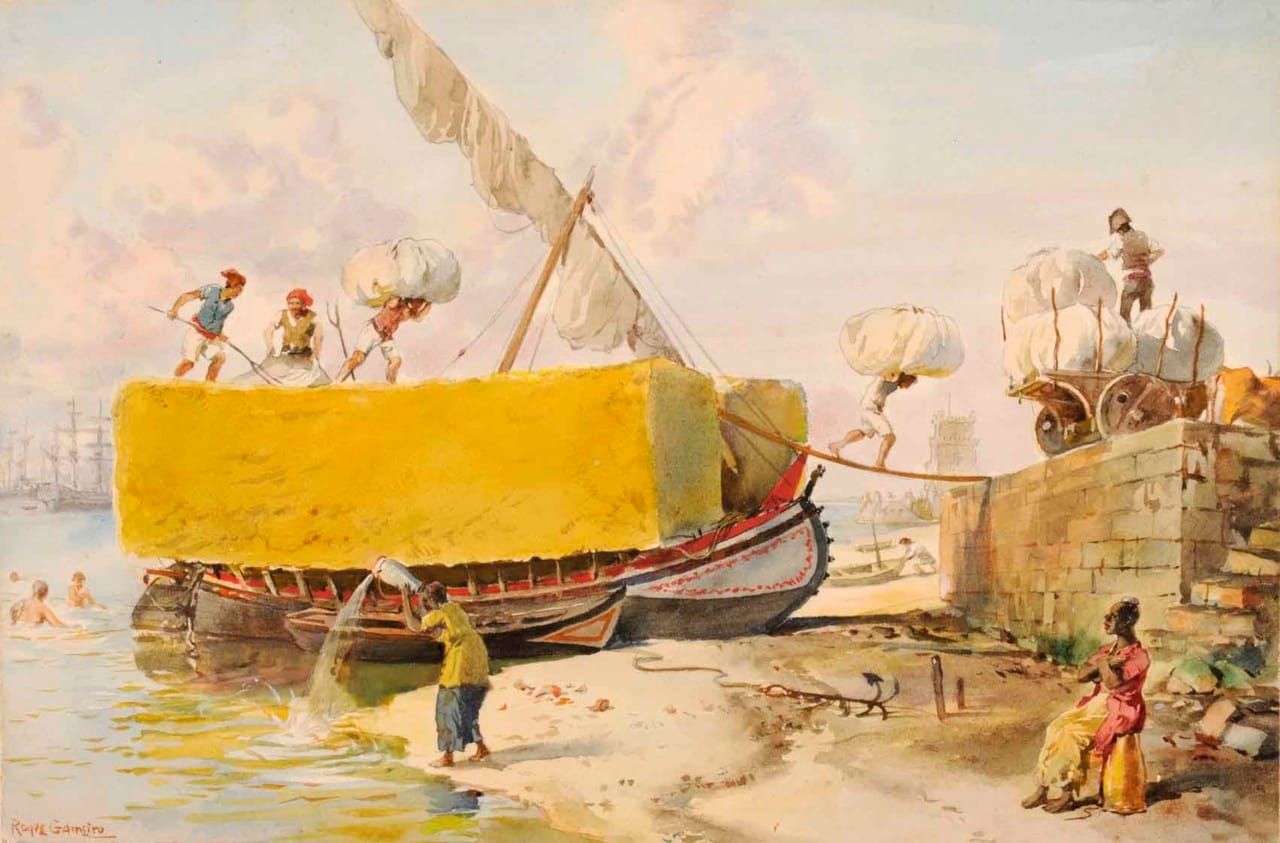
But my personal favourite is calhandrice. It’s a word I grew up hearing in my hometown of Sesimbra, usually meaning idle gossip or tattling. I loved the sound of it, but only recently learned its history — and it fits the era of slop with uncomfortable precision. Calhandrice derives from calhandro, a tall, cylindrical chamber pot used in the centuries before modern plumbing. In old Lisbon, the calhandreiras were the women — often slaves — responsible for carrying these heavy pots on their heads to dump the city’s excrement into the Tagus River. They were the literal carriers of shit. As they walked the streets with their load, they talked, exchanged news, and spread rumors. The association stuck: the transport of waste became inextricably linked to the transport of information. To engage in calhandrice is to participate in a communication network built literally on top of a sewage system. It suggests that the carrier of the message cannot help but smell of what they carry.
There’s also the expression encher chouriços—literally, “to stuff sausages.” It means producing empty discourse, padding out content without substance. You fill the casing with whatever’s available to make it look like something worth eating. The mechanics of large language models are exactly this: predicting the next token, generating words to fill space without communicative purpose beyond formal completion. The AI is, algorithmically, enchendo chouriços. This may be the most accurate Portuguese description of slop’s production process, even if it names the act rather than the product.
slop and blackout
Meanwhile, the 2025 Portuguese word of the year was apagão—blackout—chosen by Porto Editora following the massive electrical failure that paralysed Portugal and Spain on 28 April 2025. While the anglophone world debated the excess of digital light—screens full of AI-generated rubbish, feeds overflowing with synthetic content—Portugal confronted the absence of physical light. The apagão forced an involuntary disconnection that many experienced as both crisis and relief. People spoke of rediscovering conversation, of the strange quiet, of looking up from screens that had gone dark to find other people looking back.
Curiously, I think that this event generated a lot of slop, or, at least, a lot of mawkish content: people were saying how being without electricity led them to really talk to their neighbours, children, partners; how families played board games and read together in rooms lit by candles. All this, as if those actions and mentalities weren’t available on the other days. Devices still have off switches and we still can decide to say “hello” or more than that to our neighbours. Alas, I feel like an old man ranting…
The irony deserves more than a passing note. America names its condition slop—too much, too fast, too synthetic. Portugal names its condition apagão—sudden absence, enforced silence, the infrastructure failing. Both words diagnose something broken. But they point in opposite directions. One says: we’re drowning in artificial light. The other says: we’ve forgotten we depend on real systems that can fail. Both are true. They’re the same truth from different angles.
what remains
But there’s something almost hopeful in the word’s selection. That we’ve named it suggests recognition. “Slop” carries contempt. Greg Barlow, Merriam-Webster’s president, observes in an interview with the Associated Press that people “want things that are real, they want things that are genuine”—that the word represents defiance toward AI. “It’s almost a defiant word when it comes to AI,” he notes. “When it comes to replacing human creativity, sometimes AI actually doesn’t seem so intelligent.”[7]
Naming the disease may be the first step toward immunity. Or it may not. Naming has never been enough. But it’s not nothing.
The slop economy depends on our compliance or complacency. Every mindless scroll, every engagement with content we know to be worthless, every acceptance of claims we haven’t examined—each one feeds the trough. The system doesn’t require belief. Only attention. Even contempt can be monetised. Your hate-click pays the same as your love-click.
Genuine attention—the willingness to stay with complexity, to resist the easy answer, to tolerate not knowing while continuing to think—becomes a form of quiet activism.[8] Not dramatic resistance. Not the kind that makes good content or instant but ephemeral noise. The quiet kind. The kind that happens when you close the app, or don’t open it in the first place. When you sit with a difficult text instead of reaching for the summary. When you let a conversation meander without steering it toward a point. When you allow yourself to be bored, and discover what emerges from boredom that isn’t immediately filled with noise.
This won’t fix anything. It won’t fix Venezuela. It won’t restore fact to its former status or rebuild the epistemological commons. These are structural problems that require structural responses, and individual attention—however genuine—doesn’t constitute politics.
But it might preserve something. The capacity to recognise substance when we encounter it. To distinguish pig food from nourishment. To remember we were not always fed like this, and therefore might not always be.
The word “slop” entered English meaning soft mud. Something we wade through. Something that clings. Something difficult to escape.
We’re all wading through it now. The question is whether we notice the shit—or whether we’ve accepted it as the ground we walk on.
Etymology from the Online Etymology Dictionary, s.v. “slop.” The Proto-Indo-European root *sleubh- (“to slide, slip”) also produced “sleeve” (where the arm slides through) and “lubricate.” See Douglas Harper, “Etymology of slop,” Online Etymology Dictionary, https://www.etymonline.com/word/slop. ↩︎
The Old English cusloppe (literally “cow dung”) appears in the compound name of the cowslip flower (Primula veris), which grows in meadows where cattle graze. See Online Etymology Dictionary, s.v. “slop.” ↩︎
“Slopping out” was officially abolished in England and Wales in 1996, though the practice persisted in Ireland until 2019, when the Supreme Court ruled it violated prisoners’ constitutional rights. See “Slopping out,” Wikipedia. ↩︎
Online Etymology Dictionary dates this sense—“affected or sentimental material”—to 1866. Victorian critics used it to describe excessively mawkish writing or music. ↩︎
J. R. Firth coined “phonestheme” in his 1930 book Speech (London: Ernest Benn, p. 50) from the Greek φωνή (phone, “sound”) and αἴσθημα (aisthema, “perception”). For contemporary research, see Benjamin K. Bergen, “The Psychological Reality of Phonaesthemes,” Language 80, no. 2 (2004): 290–311. The sl- cluster is typically associated with frictionless motion (slide, slip, slick, sled), though many sl- words also carry connotations of wetness or negative affect. ↩︎
This progression from scheduled to continuous consumption connects to arguments I developed in “On the Beauty of Distraction” and “The Bullshit Economy,” where I examine how the attention economy converts our focus into profit for others and exhaustion for us. ↩︎
Greg Barlow, quoted in “Merriam-Webster’s word of the year for 2025 is AI ‘slop,’” Associated Press, 15 December 2025. ↩︎
For more on the relationship between attention, distraction, and resistance, see “On the Beauty of Distraction.” ↩︎
This is a reader supported publication. If you enjoy the content, please consider a paid subscription or a donation. Also, if you thought of someone while reading the content, don’t hesitate to share it with them.