

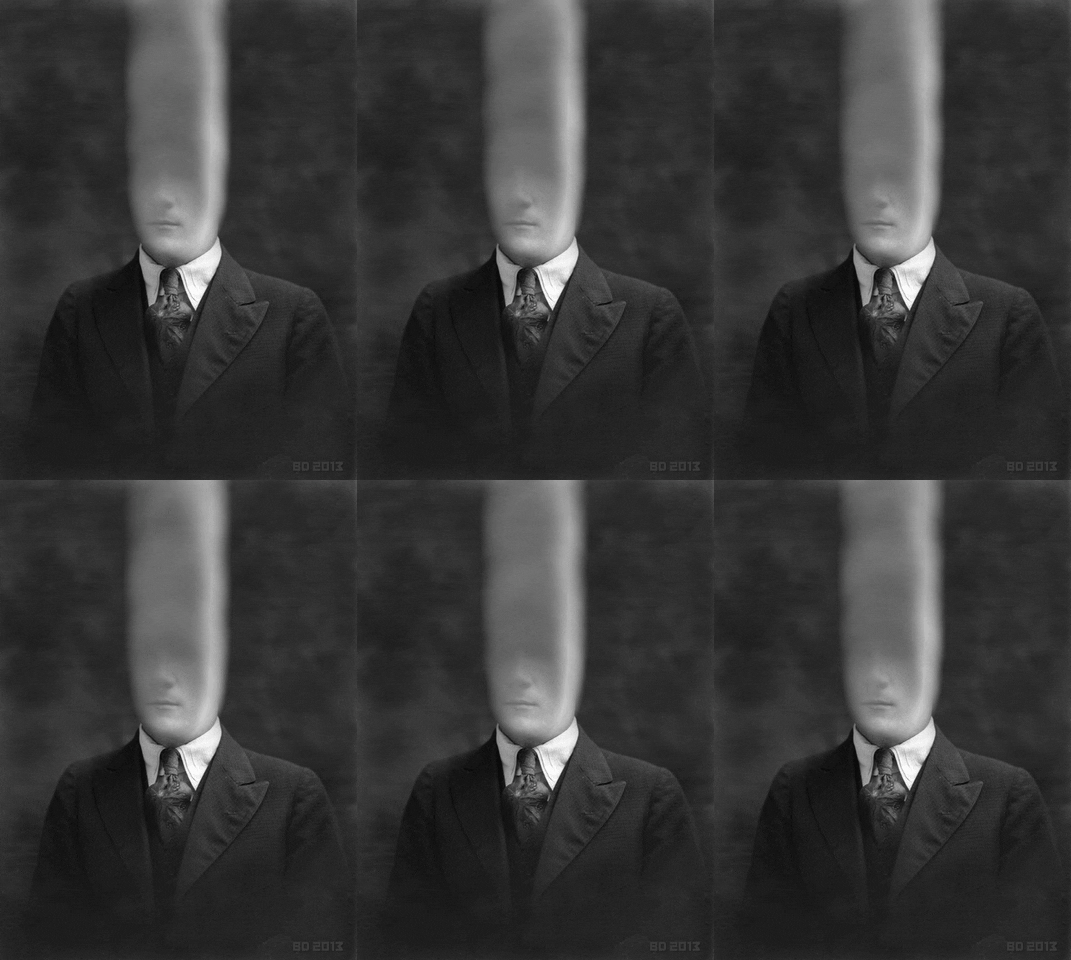
the man who was certain of his uncertainty
He was a man secure in himself, even in moments of profound insecurity.
Everyone saw him as almost always right: wise in his choices, measured in his judgments, elegant in his gestures. They considered him right even when he admitted he was wrong. His very doubts became proof of wisdom.
Faced with darkness that appeared to have no exit, he would say: “I want to believe I’m wrong, but I fear being wrong on those times when I know and feel I’m right.”
Security was illusory. A human invention to avoid facing life’s permanent ambivalence. And what a necessary invention! “Confronting the paradoxical nature of life without the necessary capacities and training leads certainly to madness,” he’d say.
In his most desperate moments, when uncertainty flooded him and the anguish of mortality tinged everything, he would cry out: “What a whore this life is! Selling itself to illusions while giving itself freely to truth…”
He lived as we all do: trapped between knowing and not-knowing, absolutely certain of his complete uncertainty.
the impossibility of standing nowhere
For this same man, objectivity was impossible; a comforting illusion that helped him swallow what few certainties made sense: that everything is uncertain, everything relative.
Memories, predictions, observations—all circumstantial, all dependent on interpretations made by specific persons at specific moments. Every perspective comes from somewhere; no one stands nowhere.
Truth had no owner; ideas roamed freely, waiting to be found. Finding truly original ideas was rare. The best tool for discovering such rarities was the question, and “how damn difficult it is,” he would exclaim, “to ask good questions!”
He was no different from others, living in constant search for meaning, trying to organize the chaos that is life.
“But what is meaning?” he would ask. “I only know what I feel, and often—too often—what I feel makes no sense at all.”
On a day like any other—though he didn’t believe identical days existed, knowing that the same person at different moments is no longer the same person—he found himself thinking: “I, who have done right things for wrong reasons and find myself doing wrong things for right reasons, what do I know about meaning?”
the journey without movement
He found himself on a journey despite never having traveled beyond familiar geographies. He felt poor for never having heard different languages in their birthplaces, spoken by people expressing desires in their native tongues.
Books provided some comfort: stories told by others, conceived in places his body had never visited. But it wasn’t enough. Though believing the mind strong and body weak, he couldn’t maintain this lie. It was too late to move; that time had passed. His weak body no longer allowed it, and his once strong mind, now also diminished by the passage of time, made movement even less possible.
The fight between desire and inability left him stuck, his energy neither growing nor shrinking. Just neutral, never enough for movement.
He found temporary salvation in Proust: “The voyage of discovery consists not in seeking new landscapes, but in having new eyes.”1 A way to leave without moving.
Yet the French writer was also his undoing. From Proust, he learned that searching for lost time would only feed frustration and disappointed expectations.
Salvation would come only when he stopped looking for what could never be found—when he started appreciating time still waiting to be discovered.
A glimmer of hope appeared when he discovered another Frenchman’s book title: “L’avenir dure longtemps” (“The Future Lasts a Long Time”).2 He tried to follow this writer’s dramatic example—someone who had to lose everything, gradually then suddenly, before beginning to find himself.
The paradox stayed unresolved: How can someone who has never left the same place become lost?
the effort that blinds
In a gallery across town, another seeker stood before a small painting with a golden frame. This was their daily ritual—examining paintings large and small, ancient and new, familiar and unknown.
This frame, with its elaborate grooves and flourishes, showed someone’s determination to make it imposing. Someone had spent lots of time making sure what mattered was inside these golden boundaries. Inside, religious imagery—something they had never cared about, something they didn’t understand but knew influenced them without their knowing how.
The imposing frame, the clear images of people from other times, covered with clothes that today would seem oddly revealing, the ambiguity of gestures you couldn’t see but only imagine—everything about this painting made them feel small before such complexity.
They struggled to see. Ironically, this struggle stopped them from even looking, despite their fixed gaze. They had to see something. They had to put energy into this task they sensed was difficult. And if difficult, then valuable—worth the time it took.
“Love your enemy,” popped into their head as they stared at the painting. Again, religion telling them even love required difficulty. The idea that value requires cost lived in their skin.
How could they really look at the painting? How could they see what was happening beyond the visible? How long would it take? This was, after all, their “work.” But where was pleasure in this effort? How could they feel love in their skin if only effort brought pleasure? Did it?
They felt envy. Envy of those who seemed to live and feel without effort. They couldn’t see that such effortlessness required its own prior effort, invisible now but once there.
This was their paradox: the harder they tried to see, the less they saw. Their effort to appreciate became the very thing blocking appreciation.
the vertigo of stillness
“To be still with a sensation of uncontrollable movement,” the person thought, “felt in the body or around it. Is this movement illusion? Delusion? Does it matter? The vertigo is real, regardless.”
What caused this vertigo? Heights? Distance from ground? Not for this one: heights never gave this feeling.
Finally, an answer emerged, though it did nothing to stop the spinning: “Vertigo, dizziness, the sensation of a still body in uncontrolled movement—these need no cliff edge, no fear, no expected fall. It’s enough that ideas and feelings run so fast they make the rest of the world seem too slow or too fast.”
Satisfied with this dissatisfaction—another paradox—the conclusion formed that while you can step back from a precipice, you can’t run away from yourself.
“Fortunately,” came the thought with a smile, “I’m not afraid of heights.”
the art of contradiction
These fragments show a deeper unity: we thrive not by resolving contradictions but by dancing with them. The certainty that certainty is impossible. The journey that happens in stillness. The effort that blinds us. The vertigo felt while standing still.
In a world obsessed with clear answers and algorithmic certainties, maybe wisdom lives in embracing contradiction rather than killing it. The spaces between opposites aren’t empty gaps to close but fertile ground where our best insights grow.
Our deepest truths come not from resolving tensions but from living within them—not finding middle ground between opposites, but holding opposites at the same time. It’s in these contradictions that useful uselessness lives, where meaning shows up not as answer but as question.
Maybe this is what makes us human: not our hunger for certainty but our skill at navigating uncertainty—standing firmly on shifting ground, finding ourselves by getting lost, seeing clearly by giving up the effort to see.
The paradox stays open. As it should.
- Marcel Proust, The Captive & The Fugitive (Vol. 5 of In Search of Lost Time), translated by C.K. Scott Moncrieff and Terence Kilmartin, revised by D.J. Enright (Modern Library, 1993). The original quote in French is: “Le seul véritable voyage, le seul bain de Jouvence, ce ne serait pas d’aller vers de nouveaux paysages, mais d’avoir d’autres yeux.” ↩︎
- Louis Althusser, L’avenir dure longtemps, suivi de Les Faits (Stock/IMEC, 1992). Published in English as The Future Lasts Forever: A Memoir (New Press, 1993). Althusser was a Marxist philosopher who, during a psychotic episode, strangled his wife Hélène Rytmann in 1980. Declared unfit to stand trial, he was committed to a psychiatric hospital and wrote this memoir as a form of reckoning with his life and this tragedy. The text was published posthumously after his death in 1990. ↩︎